
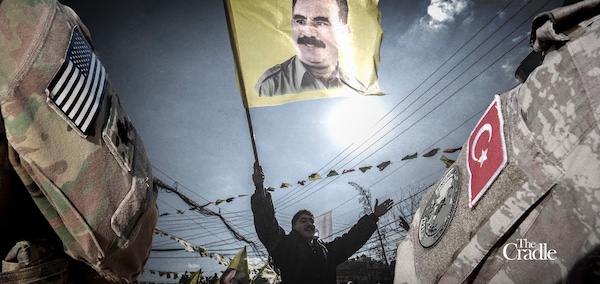
All Turkish—Kurdish understandings—those tied to the Hayat Tahrir al-Sham (HTS)-led authority in Syria, and which, only a month ago, appeared imminent—now lie in ruin.
While signs once pointed to a new form of field settlement between Ankara and the Kurds, indirectly brokered by Damascus, recent developments have made clear that the opposite is unfolding as complications increase, alliances shift, and agendas clash.
This collapse extends beyond the military—security negotiation track. It casts doubt on the entire regional calculus in northern Syria, where the interests of Turkiye, the U.S., and Israel collide.
On the ground, the swift undoing of what seemed like near-final deals following jailed Kurdish leader Abdullah Ocalan’s letter in late February ahead of Nowruz (Persian/Kurdish New Year), urging the Kurdistan Workers Party (PKK) to end its armed struggle, has exposed just how fragile that moment was.
Ocalan’s new strategy: From separatism to integration
I do not believe in the power of weapons, but in the power of politics and social peace—I urge you to follow the same principle.
In his 9 July address to PKK cadres, Ocalan announced a shift in direction, offering a new vision to resolve what he called the movement’s deepening internal crisis. His televised message marked a definitive rupture with the party’s historic strategy of armed liberation and statehood, urging a transition to what he termed “peace and democratic society.”
In his letter, Ocalan encourages Turkiye’s Kurds to embrace “democratic politics” as a path to self-determination. He proposed forming a parliamentary committee to oversee voluntary disarmament within a legal framework, framed as a gesture of good faith toward the Turkish government.
At the heart of his appeal was a call for integration. “Peace and democratic society,” he said, require “a positive, integrationist outlook.” According to Ocalan, the PKK had now renounced the nation-state model and armed struggle that had lasted almost forty years and cost around 40,000 lives.
He claimed this was not a defeat but a victory, and that parliamentary allies like the pro-Kurdish Peoples’ Equality and Democracy Party (DEM) would carry forward the new strategy.
Yet even Ocalan warned that this “solution” remains ambiguous. He cautioned that,
to render the committee’s and parliament’s work meaningful and allay public concerns among Kurds, and to fulfill our commitments to the Turkish state, the disarmament initiative must be welcomed by the relevant [Turkish] parties.
He added that the creation of a disarmament mechanism will help facilitate the voluntary end of the Kurdish armed struggle and the transition to lawful democratic politics.
Turkish parliamentary speaker Numan Kurtulmus soon echoed the call, urging parties to nominate members to a 51-person committee aimed at building a “terror-free Turkiye.” The body would focus on constitutional and legal reforms that could enshrine Kurdish rights and possibly secure the release of imprisoned Kurdish leaders.
On 31 July, the committee was formally established with representation from all parliamentary blocs. Its first meeting, held in Ankara on 5 August, was convened to address legislative reforms in response to the PKK’s disarmament declaration.
Kurtulmus, presiding over the session, argued that there was broad political consensus supporting the committee, claiming that this represented 98 percent of the parliament’s will. He described the meeting as a step toward unity and fraternity and pledged that transparency would guide the committee’s work in safeguarding peace.
Yet these reforms, which Ocalan insisted must be protected by law, are already encountering political fragmentation. Assistant professor of America Studies at the Social Sciences University of Ankara (ASBU), Barin Kayaoglu, has argued that Ankara’s disarmament initiative faces deep skepticism—not just from Kurdish factions but within Turkiye’s own divided political class.
He also noted that “Ankara’s growing impatience over the SDF’s [Syrian Democratic Forces] integration with Damascus is closely linked to the ongoing efforts inside Turkiye, which is aiming to fully disarm the PKK.”
Turkiye’s geopolitical dilemma
The PKK’s armed separatist movement has destabilized Turkiye’s internal geopolitics for nearly half a century. Its reach extended from the periphery to major cities, and even into the capital. The Kurdish challenge itself was born from the post-Ottoman construction of the modern Turkish state.
That is why the question now is not simply whether the PKK has truly renounced its struggle, but whether the so-called integration solution is even feasible.
Symbolically, the PKK’s first step was the staged destruction of light weapons in the “Jasana cave” in Iraq’s Qandil Mountains, a gesture orchestrated not on Turkish soil, but in a neighboring state under the watch of Turkish intelligence. That in itself revealed the limits of the process.
Turkish officials quickly moved to frame Ocalan’s letter on their own terms. Two days after the Jasana event, Turkish President Recep Tayyip Erdogan addressed AKP leaders, triumphantly declaring:
Turkiye has won. Eighty‑six million citizens have won… We know what we are doing. Nobody needs to worry or ask questions. We are doing all this for Turkiye, for our future.
He spoke of a new era aimed at creating a “terror-free Turkiye.” The Erdogan-led Justice and Development Party’s (AKP) spokesperson Omer Celik echoed this, describing Ocalan’s decision to pursue integration, dissolve the PKK, and disarm as a “major step toward a terror-free Turkiye.” Foreign Minister Hakan Fidan issued similar statements.
Kurdish politicians also embraced the initiative, framing it as a moment of historic transformation, not just for Kurds in Turkiye but across West Asia. They called it a call to transition “from war to partnership, from division to pluralism, from oppression to democratic participation.”
Geopolitical blowback: Syrian reality intrudes
The celebration did not last. One month later, the entire premise appears to be unraveling. Instead of boosting Ankara’s regional role, the new geopolitics has strengthened Kurdish separatist currents.
In Syria, where Turkiye helped dismantle the state, the U.S.-Israeli axis has imposed limits on Ankara’s ability to resolve the status of the Kurdish-led SDF.
Negotiations between the SDF and the Damascus-based transitional government, including a landmark 10 March agreement integrating SDF-controlled civil and military institutions into state structures, reveal a growing potential for a Kurdish political presence to be formalized within Syria’s new political order.
In July, U.S. envoy and Ambassador to Turkiye Tom Barrack made clear that the SDF remains an offshoot of the PKK, stating,
SDF is YPG. YPG is a derivative of the PKK.… There’s no indication there’s going to be a free Kurdistan, … There’s Syria.
Back in February, French President Emmanuel Macron implored the Al-Qaeda-rooted Syrian interim government to “fully integrate” the SDF into Syria’s political transition, calling them “precious allies.”
As Kurdish influence shrinks in Anatolia, it expands across the Levant, underwritten by the U.S., Israel, and France. The developments shaping Turkish—Kurdish relations are now being dictated by forces beyond Turkiye’s borders.
The Atlanticist trap
Ocalan referenced “recent regional developments” as the driving force behind his message. These arguably included Israel’s ongoing genocide in Gaza, the 27 November 2024 ceasefire agreement between Lebanon and the occupation state, and the collapse of Syria’s prior government on 8 December—events that further fractured Syria’s internal cohesion.
Amid all this, Turkiye has remained sidelined. Its failure to counter the fragmentation of Syria is not the result of hesitation, but of deeper structural constraints. As a NATO member that hosts U.S. nuclear bases, Ankara’s foreign policy is tethered to Atlanticist agendas—even when these run counter to its own national interests.
This is why the Turkish army, once willing to confront Damascus militarily, refrains from striking the U.S.-backed Kurdish militias. Those militias are protected not by moral legitimacy, but by their utility to Washington.
It is possible that both Qandil and Ankara entered into their agreement under the illusion that the Axis of Resistance had collapsed and that the regional deterrence system opposing the U.S. and Israel had dissolved.