
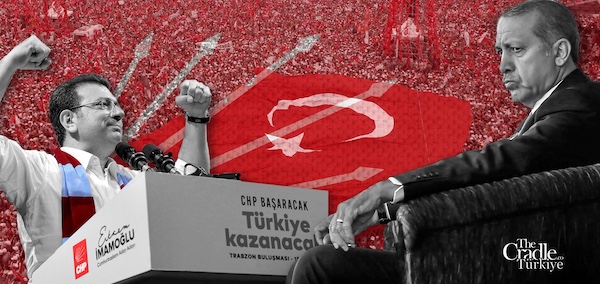
On 15 September, Turkiye witnessed the third hearing in a case to annul the opposition Republican People’s Party (CHP) congress, Turkiye’s main opposition party, in which Kemal Kilicdaroglu was ousted by Ozgur Ozel as new leader.
The lawsuit, widely expected to succeed, was postponed until 24 October, prolonging a manufactured crisis designed to paralyze the country’s main opposition force.
This judicial maneuver is part of what the ruling Justice and Development Party (AKP) has effectively turned into state policy: a strategy of “de-electoralization.” While not abolishing elections outright, this approach seeks to render the ballot box meaningless. It aims to ensure President Recep Tayyip Erdogan remains in power for life, and that his chosen successor can continue to rule unchallenged.
Criminalizing opposition, consolidating control
To facilitate this, the main opposition party, the CHP, has been reclassified as an “internal enemy” and subjected to a kind of “enemy law.” Last month, Burhanettin Bulut, a deputy leader of the CHP, was quoted by the Associated Press (AP) as saying the AKP party “politically named the new enemy on March 19—(and) the new enemy is the CHP.”
The primary front of this campaign has been the CHP-led municipalities. Numerous provincial and district municipalities governed by the CHP have been subjected to operations under the pretexts of “corruption” and “collaboration with terrorism.” Many mayors and bureaucrats have been arrested and imprisoned.
Most prominently, Istanbul Mayor Ekrem Imamoglu—also the CHP’s former presidential candidate—was imprisoned after his university diploma was retroactively annulled, disqualifying him from holding office.
Imamoglu was then detained on corruption charges, with a separate case opened accusing him of links to terrorism. Neither he nor the other detained CHP officials have been formally indicted. They remain behind bars, without trial dates.
This strategy has been replicated across Turkiye, with elected officials pressured or blackmailed into defecting to the ruling party, thereby flipping control of local governments without a single vote cast.
But the campaign has now extended beyond municipalities to the CHP’s national leadership. Through its grip on the judiciary, the government is attempting to nullify the results of the party’s last congress and reinstall Kilicdaroglu at the helm—a move intended to fracture the opposition and neutralize its electoral threat.
De-electoralization meets disarmament
This push to hollow out Turkiye’s electoral system coincides with another development: a renewed attempt to resolve the Kurdish issue through disarmament of the Kurdistan Workers Party (PKK). The two tracks, far from unrelated, are deeply intertwined.
Last year, Erdogan launched a rhetorical campaign to “strengthen the domestic front” against alleged Israeli threats. He invoked Israeli attacks on Gaza and Lebanon as a prelude to an impending assault on Turkiye. But the real aim of this call for unity was not to confront Tel Aviv, but to reconfigure domestic power balances.
In Erdogan’s new equation, the CHP was cast as the internal enemy, while the Kurdish political movement, historically aligned with the opposition, was invited to the negotiation table via the PKK’s dissolution and disarmament.
It was the Nationalist Movement Party (MHP)—Turkiye’s largest Turkish nationalist party and the ruling party’s unofficial coalition partner—that carried this call forward. On 1 October last year, during the opening of parliament, MHP leader Devlet Bahceli shook hands with members of the pro-Kurdish Peoples’ Equality and Democracy Party (DEM Party), which had been founded to replace the People’s Democratic Party (HDP), a party he had recently called to be shut down.
Bahceli said he did so in support of Erdogan’s call to strengthen the domestic front. Not long after, he made the startling suggestion that PKK leader Abdullah Ocalan, imprisoned for 26 years, should be brought to parliament to call on the PKK to disarm.
State officials had already resumed secret contacts with Ocalan, signaling the early stages of a new resolution process. This time, the scope expanded beyond Turkiye’s borders. The disarmament of the PKK’s Syrian offshoot, the People’s Protection Units (YPG), was also placed on the table. Ankara hoped that by leveraging Ocalan’s authority, both the PKK and YPG could be compelled to lay down arms.
In late February, Ocalan re-emerged from isolation with a letter, read by a DEM Party delegation, calling on the PKK to disarm and abandon all demands outside democratic channels.
The PKK publicly complied, holding a symbolic disarmament ceremony in Iraq’s northern Kurdish region, and stating that complete demobilization would follow if the state honoured its side of the agreement. A parliamentary commission was subsequently formed to prepare a legal framework.
A manufactured threat reshapes the home front
Despite official rhetoric, this new political realignment has little to do with “Israeli threats.” The NATO member lacks the autonomy to directly confront Tel Aviv, given its strategic dependence on the U.S. The invocation of Israel serves primarily as a domestic rallying tool, a means of projecting nationalist resolve and manufacturing legitimacy.
In practice, Turkiye has been unable and unwilling to counter Israeli actions in Syria, where Tel Aviv has regularly bombed positions linked to Turkiye-backed Hayat Tahrir al-Sham (HTS) forces. Nor could Ankara respond meaningfully when Israel targeted Hamas members in Qatar, a red line even for U.S.-aligned Arab states.
Far from preparing for war with Israel, Erdogan is preparing the battlefield at home. And the Kurdish question sits at the heart of that terrain. By turning the CHP into a pariah and drawing the Kurdish movement into its orbit, the government hopes to break the opposition’s electoral spine.
Whether the PKK and YPG will comply remains uncertain. Both have rejected Ankara’s claim that the call to disarm applies to them equally, insisting that Ocalan’s appeal was directed only at the PKK. Earlier this year, Turkish officials threatened renewed operations in Syria if YPG refuses to dissolve.
The process could unravel over Syria. Or it could pause there, with Kurdish factions disarming within Turkiye, but retaining arms in Syria. Either way, the government’s goal is clear: secure Kurdish political backing for one final Erdogan presidential term.
Rebuilding power through fragmentation
Ultimately, the de-electoralization drive and the Kurdish peace track form two pillars of the same project: preserving the status quo. They are not mere crisis responses, but a deliberate architecture for a post-electoral, semi-authoritarian system in Turkiye.
Whether this plan succeeds depends on the opposition. Will the courts annul the CHP congress? Will a state-appointed trustee take over the party? Can the government engineer a CHP split and render elections meaningless?
These questions hinge not on legal outcomes, but on political resistance. Reports say that Ozel and Kilicdaroglu may hold a meeting this week, with MP Murat Emir possibly hosting to help resolve internal party tensions. If the opposition, and its popular base, can mobilize an effective counter-strategy, they may yet block this authoritarian pivot. If not, Turkiye will enter a new political era, one shaped not by the ballot, but by decree.