

As the climate crisis deepens, the detrimental social impacts of climate change have been well documented, both globally and specifically in regions of the Global South. The landscape of climate finance has been influenced by growing pressure to recognise these social impacts and to integrate them into funding streams, policy initiatives, and frameworks. However, many of the fundamental issues raised by the Global South remain unaddressed. In fact, the landscape of climate finance as it has emerged is likely to aggravate the adverse social impacts of climate change and inequalities in developing countries, with racial, gendered and class dimensions. Among the different sources and instruments of climate finance that have been rolled out, a significant share comes from private sources and takes the form of debt or profit-oriented investment instruments.
Here, we examine three types of financial instruments promoted as tools for financing social policy that supports climate action in the Global South. These include Municipal Green Bonds (MGBs), green microfinance, and carbon markets for gender empowerment. All three are market-based instruments that claim to deliver a dual impact: advancing climate and environmental goals while also producing positive social outcomes. They have been promoted in Global South countries as a way to fill the so-called “financial gap,” enabling governments and local authorities to raise the capital needed for climate action while addressing the social impacts of climate change. We demonstrate how social welfare goals have been co-opted and absorbed into a corporate logic of growth, profit, and brand management through the rollout of such instruments.
Municipal Green Bonds
Municipal Green Bonds (MGBs) illustrate the use of municipal debt for adaptation projects, often adopted by subnational governments facing austerity and funding shortages. MGBs are debt securities issued by local or regional governments and labelled “green” to signal that the investment has climate- or environment-related objectives.
In Mexico, South Africa, Morocco, and Argentina—countries in the Global South where MGBs have been introduced—there are usually two types of municipal bonds, depending on the source of income used to repay the debt. The first are revenue bonds, which are expected to be paid back with the returns generated by the financed projects (for example, revenue from higher water bills following investments in water infrastructure). The second are general obligation bonds, which rely on the regular income sources of the local government issuing the bond (e.g., taxes).
In Cape Town, South Africa, a severe drought between 2016 and 2018 prompted the local government to issue an MGB worth US$75 million on the Johannesburg Stock Exchange in 2017. The funds were directed primarily to the Water Management Devices (WMDs) programme for ‘indigent’ households, to “enhance water management, influence behaviour to reduce water wastage and reduce water losses through leakage” (Herrera 2024: 155).

Water conservation message on retaining wall at Cape Town waterfront. Photo: Daniel Case
Most of the ‘indigent’ households in Cape Town are located in Black and Coloured majority low-income neighbourhoods. Under this scheme, such households received a daily water quota of 350 litres – once the quota was used, water access was suspended until the next day. This quota was applied with little consideration for how households were enumerated, with one device covering several different families and large numbers of individuals in informal settlements under a single ‘household’. It was considered highly inadequate and also a typical case given the number of people that constitute typical households in poor neighbourhoods
The policy, where municipal green debt finances an environmental initiative, ended up severely restricting water access for these communities, against the backdrop of a racial divide. Research found that rather than driving transformative municipal change, the city continued projects that entrenched existing inequalities. Moreover, using municipal debt for adaptation intensified financial and environmental risks, which were borne primarily by poor and working-class communities of colour.
Households reported that they had no role in decision-making processes, despite the MGBs being issued by local authorities. They had limited understanding of how the devices worked or why they suddenly shut off, which worsened the water scarcity crisis. Women were disproportionately burdened with managing these new water restrictions. Herrera (2024: 164) found that ‘The issuance of the MGB and the allocation of proceeds to the WMDs triggered a financial distribution through which the bond buyers collected profits while taxpayers and water tariff payers contributed to repaying the municipal green debt’. In addition, there was a narrowing of options for the structural changes needed for just climate adaptation.
Green Microfinance for Gender Empowerment
Microfinance has long been one of the most widespread financial tools directed primarily at women for several decades now. In recent years, under a ‘microfinance turning green’ strategy, a variety of microfinance tools emerged from within the microfinance sector, combining the move towards financial inclusion with environmental sustainability, ostensibly motivated by ‘ethical considerations, financial risk management and the exploration of new business opportunities’ (Gilchrist et al 2021: 480). Combined with environmental organisations or conservation projects turning to microfinance – ‘green turning to microfinance’, it is supposedly a win-win approach to tackling both social and environmental problems, in a financially sustainable way.

Microfinance loan scheme explained to women farmers in Tajikistan. Photo: UNDP
Apart from the provision of microfinance for green projects, mostly in renewable energy adoption, sustainable agriculture, clean cooking solutions, and water conservation, a variety of tools have been developed to assess whether the objectives of green microfinance are being met by supported projects. Examples of such tools are the Microfinance Environmental Performance Index (MEPI) and the Green Index, which bring in various categories of risk into the discussion. Risk factors for investing in particular projects that are considered are: the degree of environmental impact of an MFI through the activities of their clients; the environmental risks to which microfinance clients (and hence MFIs) are exposed, including climate change, changes in soil fertility, deforestation, etc; and risks of default of clients. These risks, built into the rates of interest, terms and duration of repayment of the microcredit that is provided, essentially mean that the clients, or the target populations encounter conditionalities that offset risks for the lenders.
Ironically, the very problems that these loans are intended to address – climate-related vulnerabilities – are the same risks that make them more expensive. In other words, the socio-economic impacts of climate change become factors that raise the cost of borrowing. Given the long history of predatory practices in microfinance, its “greening” represents a classic case of what Dafermos (2025) calls “exposing by self-protecting.” Here, private finance safeguards itself from climate risks while engaging in “climate derisking,” creating new low-risk, profitable opportunities for investment in the Global South.
Voluntary Carbon Markets for Gender Empowerment
Carbon offsetting measures and voluntary carbon markets (VCMs) are being promoted in developing countries as an important example of the ‘business case’ for gender equality. The VCM is a carbon pricing instrument (CPI) in which entities trade carbon credits, also known as offsets, each representing one tonne of CO2 equivalent (tCO2e) from projects that remove or avoid greenhouse gas (GHG) emissions. Various CPIs have been used worldwide, including carbon taxes, emissions trading systems, and offsetting programs. Some CPIs, such as carbon taxes, have been found to place a greater burden on women (Nicholson and Besco 2025).
The VCM, as a climate change mitigation tool, it is argued, can ‘reduce risks to gender equality within offset projects, mainstream SDG5 considerations, and create opportunities for SDG5 contributions… encouraging women’s participation due to their effectiveness as environmental decision-makers’ (Nicholson and Besco 2025). The VCM is also voluntary, which implies that organisations can choose and in fact ‘be encouraged’ to buy and sell credits to gain advantages for gender empowering and carbon offsetting projects. The VCM operates through carbon market registries such as Gold Standard and Verra, which can register projects for trading and are evaluated with regard to whether or not they adhere to various SDG outcomes, including advancing gender equality. The proceeds from the VCM are expected to be utilised for gender positive outcomes.
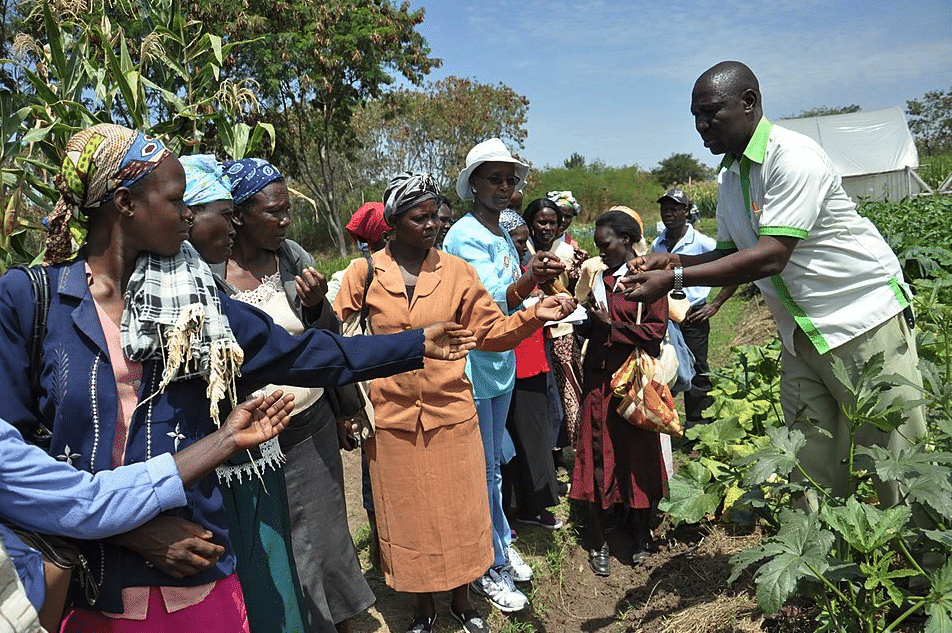
Women farmers trained on climate smart innovations in Kenya. Photo: CCAFS
Despite critiques that point out lack of market regulation, poor climate performance of markets, the social inequalities they reinforce and generate, and misuse/manipulation by actors uninterested in climate mitigation, VCMs are being considered as useful instruments for gender-sensitive climate change policy. Both Verra and Gold Standard have published studies (Nicholson and Besco 2025) showing that there is a deficit in the supply of carbon credits that are delivering meaningful impacts for women and that women’s organisations or others that work in areas to do with gender equality are not voluntarily operating in VCMs. The problems identified are, first, that buyers and intermediaries can find it difficult to identify good projects due to the absence of high-quality, comparable labelling; and second, the issue of pricing, because the high cost of investment in gender integration results in a higher price (gender price premium), in turn discouraging investors.
What needs to be pointed out here is that, like other market-based mechanisms, the engagement with VCMs for women and organisations working on gender issues is shaped by a profit-and-return oriented logic of investment. This logic, combined with the lack of regulation and the high costs of both regulation and intermediary processes such as registration, labelling, and other mechanisms that are meant to provide ‘full information’ to investors, makes the VCM an unlikely mechanism to deliver benefits for climate- and gender-friendly activities. It is even less likely to benefit poor women in the Global South. Even when these problems are recognised, the focus tends to shift toward arguments for better regulation and governance, rather than questioning the reliance on market-based mechanisms themselves. As a result, the responsibility for making markets accountable is shifted onto the very communities that are most affected by climate change.
To conclude, whether we look at market-based debt instruments like MGBs, green microfinance, or trading in VCMs, it is the imperative of generating returns for private players and financial institutions that drives the ‘greening’ of these financial instruments. Believing that such instruments can deliver both ecological and social benefits in the Global South, particularly for poor and marginalised communities, is misguided. In reality, they are far more likely to aggravate existing class, racial, and gender inequalities.