
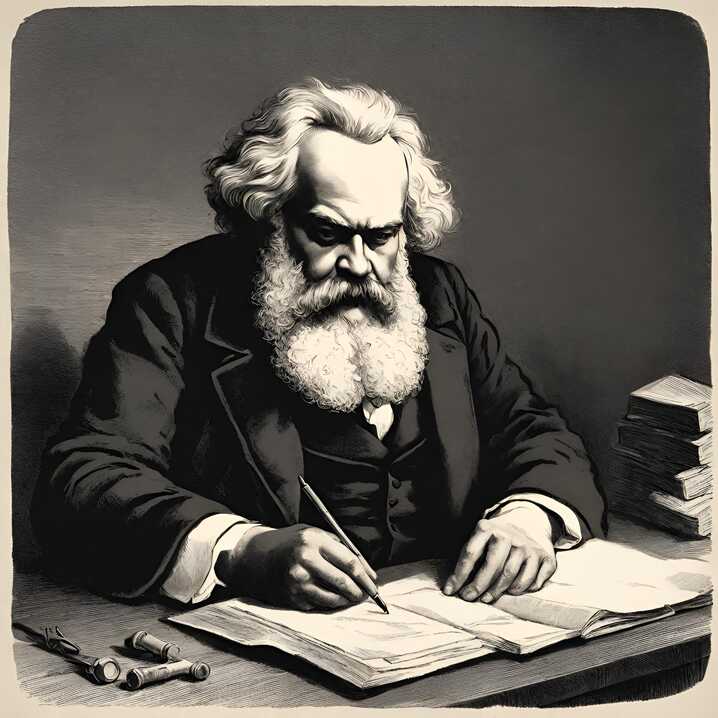
This is the third and final post of a mini-symposium on Karl Marx’s ‘Critique of the Gotha Programme’, which was published a hundred and fifty years ago. The contributions to the symposium were first presented in the Conference ‘Communist Alternative: 150 Years From Marx’s ‘Critique of the Gotha Programme’, on 17 May 2025 at Panteion University in Athens. Extended versions of these papers will appear in the Greek language in a forthcoming edited volume, to be published in 2026 by Topos Publications.
Introduction
Marxism, in both its classical and later forms, unites theoretical analysis with political positions. It arose in a historical moment when the conscious transformation of capitalist relations became possible. As such, Marxism aims at the revolutionary transformation of society, and its politics are grounded not in empiricism or arbitrariness but in rigorous theoretical analysis of social reality. It is important here to clarify what Marx means by theory. He uses the term broadly, encompassing both critical and non-critical approaches to reality. Yet when he refers to a mode of inquiry endowed with cognitive rigor and critical validity, he prefers the term science. In Marxism, then, theory largely coincides with the scientific, critical examination of reality; Marxist politics is anchored in this scientific grasp of the social world. The tight coupling of theory and transformative praxis gives Marxism a distinctive, internally contradictory character. So long as the task of overcoming capitalist relations and moving toward a new society endures, elements of Marxism’s theory and positions retain their force. Yet capitalist relations and their contradictions evolve within determinate historical conditions; each attempt to build a new society on concrete historical circumstances generates new theoretical and political problems that cannot be addressed solely within the anti-capitalist framework. Theory and politics must therefore be permanently reworked to meet historically specific transformative tasks. For these reasons, Marxism is a system in development, marked by continuity and discontinuity. Continuity lies in its drive for a scientific understanding of the social and its conscious transformation, which confers unity on its fundamental analyses and core political positions. Discontinuity stems from Marxism’s developmental logic: the further elaboration of existing theses, the encounter with new phenomena, and the questions opened by attempts at socialist construction continually redefine its theoretical and political positions.
In what follows, I reconstruct several central aspects of Marxist political theory and clarify their grounding. I highlight enduring Marxist positions while problematizing certain elements and underscoring the need for renewed elaboration in light of contemporary stakes. My focus is Marx’s Critique of the Gotha Programme,[1] a late text that articulates key reflections on politics and the transition to a classless society. Addressed to the distorted positions of the German Workers’ Party and situated within nineteenth-century European capitalism and its class struggles, the Critique nonetheless exceeds its context: it furnishes the core foundations of Marxist political theory. Through Marx’s critique, the basic lineaments of that theory and their theoretical grounding become visible.
Distribution and Relations of Production
Marx grounds the necessity of overcoming capitalist society and transitioning to the communist society in a concrete analysis of capitalist relations of production. Capital offers the most systematic presentation of the relation between production and distribution—that is, of the internal structure of capitalist relations of production. Volume I examines the production of surplus-value and accumulation; Volume II, the realization of surplus-value in circulation; and Volume III, the distribution of the total surplus-value. Although the relationship between production, distribution, appropriation, and property is analysed primarily in the form it assumes under capitalism, Marx emphasizes that the generality of this relation characterises every historical mode of production. Moreover, studying the structure of relations of production in the capitalist mode of production allows for a deeper understanding of those relations in earlier historical forms. As Marx notes:
Bourgeois society is the most developed and the most complex historic organization of production. The categories which express its relations, the comprehension of its structure, thereby also allows insights into the structure and the relations of production of all the vanished social formations out of whose ruins and elements it built itself up, whose partly still unconquered remnants are carried along within it, whose mere nuances have developed explicit significance within it, etc.[2]
Already in the Grundrisse, therefore, Marx develops a systematic view of the general structure of relations of production within every socio-economic formation. The relation between production and distribution thus functions as a conceptual model for grasping the basic structure of the relations of production in any society. This, in turn, allows us to determine the theoretical grounding of various political positions, as shown in the Critique of the Gotha Programme.
Marx’s account of the structure of relations of production rests on distinguishing three interlinked functions of distribution: (1) the distribution of the products of production; (2) the distribution of the means of production; and (3) the distribution of individuals among the different branches of production.[3] These three functions together constitute the nexus of relations of production, though each bears a different weight within it. The most superficial function is the distribution of products. Next comes the distribution of the means of production, which in capitalism takes the form of the opposition between the class that owns the means of production and the working class. Most decisive is the third function: the social division of labour and the distribution of individuals across productive branches, accompanied by the distinction between manual and intellectual labour. As Marx stresses:
In the shallowest conception, distribution appears as the distribution of products, and hence as further removed from and quasi-independent of production. But before distribution can be the distribution of products, it is: (1) the distribution of the instruments of production, and (2), which is a further specification of the same relation, the distribution of the members of the society among the different kinds of production. (Subsumption of the individuals under specific relations of production.) The distribution of products is evidently only a result of this distribution, which is comprised within the process of production itself and determines the structure of production.[4]
In the third point of his Critique of the Gotha Programme, Marx identifies the error of the German Workers’ Party in overemphasizing “fair distribution.” As he writes: “What is “a fair distribution”? Do not the bourgeois assert that the present-day distribution is “fair”? And is it not, in fact, the only “fair” distribution on the basis of the present-day mode of production?”.[5] The claim for “fair distribution” refers exclusively to the distribution of means of consumption. Yet Marx’s analysis shows that this is only the external aspect, determined by the two deeper functions of distribution. As he notes:
The structure of distribution is completely determined by the structure of production. Distribution is itself a product of production, not only in its object, in that only the results of production can be distributed, but also in its form, in that the specific kind of participation in production determines the specific forms of distribution, i.e. the pattern of participation in distribution.[6]
Here Marx’s critique of the German Workers’ Party reveals itself as an early critique of the fundamental theses of social democracy. As he writes, ‘vulgar socialism (and from it in turn a section of the democrats) has taken over from the bourgeois economists the consideration and treatment of distribution as independent of the mode of production and hence the presentation of socialism as turning principally on distribution’.[7] The core of social-democratic politics lies precisely in restricting itself to the first function of distribution—regulating the distribution of products—without aiming to transform the deeper ones. This means rejecting the very possibility of revolutionary social transformation. Marx’s critique thus retains its full relevance: there can be no revolutionary politics when the distribution of means of consumption is posited as the main political goal, independently of the other conditions of production. This critique of social democracy exemplifies the moment of continuity in Marxist theory and politics and is grounded in the systematic analysis of the nexus of relations of production. With the rise of large-scale industry, the social character of labour becomes a technical necessity, and production no longer relies on the individual skills of separate workers.[8] Consequently, on the one hand, the product is generated by the cooperative activity of socialized labour; on the other, its distribution is determined by private property in the means of production. As Marx underscores in the Critique of the Gotha Programme:
At any given time, the distribution of the means of consumption is only a consequence of the distribution of the conditions of production themselves. The latter distribution, however, is a feature of the mode of production itself. The capitalist mode of production, for example, rests on the material conditions of production being in the hands of nonworkers in the form of property in capital and land, while the masses are only owners of their personal prerequisites of production, of labour-power.[9]
Thus the contradiction deepens between the social productive organism—which generates the social product through its interaction with nature—and the distribution of that product based on private property in the means of production. This is a contradiction internal to the distribution of the means of production, which manifests outwardly at the level of product distribution. Overcoming this contradiction requires transforming the property relations of the means of production themselves. Hence the basic Marxist political thesis: revolutionary politics presupposes the expropriation of private property in the means of production by the working class and the establishment of social ownership. As Marx writes, ‘if the material conditions of production are the cooperative property of the workers themselves, then there likewise results a distribution of the means of consumption different from the present one’.[10]
Continuing in the third point of his critique, Marx outlines the functioning of distribution in communist society. The analysis remains grounded in the theoretical model of the nexus of relations of production. He first distinguishes explicitly between a lower and a higher phase of communism, recognizing that communist society initially emerges from capitalist society and bears its birthmarks:
Here we are dealing with a communist society, not as it has developed on its own foundations, but, on the contrary, just as it emerges from capitalist society; which is thus in every respect, economically, morally, and intellectually, still stamped with the birthmarks of the old society from whose womb it emerges.[11]
This conception underlies Marx’s view of the necessary preservation of the state in the first phase of communism and his critique of anarchism and later post-Marxist positions that deny the necessity of a socialist stage. Socialism, as the lower phase of communism, is grounded in the third and most decisive function of distribution: the distribution of the members of society among the different branches of production. From the standpoint of the nexus of relations of production, the principal transformation on the transitioning to communist society concerns the second function—namely, the distribution of the means of production. Yet this transformation is not sufficient for the higher phase, since the distribution of individuals across productive branches depends primarily on the level of productive development and on the social character of labour.[12] The crucial inheritance from capitalist prehistory is thus the birthmark of the division of labour—the necessary distribution of individuals to different productive branches, taking the general form of the division between manual and intellectual labour.
At this point the question about class in socialist society comes to the fore. For Marx, socialism is the lower phase of classless society. One might therefore assume the absence of classes. Indeed, with the establishment of social ownership over the means of production, capitalist social classes cease to exist. Yet the absence of classes does not imply the absence of class character or social stratification. Since the division of labour remains—maintaining the distinction between manual and intellectual labour—the members of society continue to occupy unequal social positions. Some forms of labour carry greater social significance and complexity, implying higher reproduction costs for those who perform them. Consequently, forms of social differentiation and hierarchy persist, producing degrees of class character even without fully constituted social classes. Therefore, socialism remains ‘in itself’, and not yet ‘for-itself’, a truly classless society. It is a transitional form characterized by the class character and social stratification without classes. As long as the structure of production makes the distinction between manual and intellectual labour necessary, the socialist stage—and with it institutions such as the state and right—must persist. As Marx writes:
In a higher phase of communist society, after the enslaving subordination of the individual to the division of labour, and thereby also the antithesis between mental and physical labour, has vanished; after labour has become not only a means of life but life’s prime desire and necessity; after the productive forces have also increased with the all-round development of the individual, and all the springs of cooperative wealth flow more abundantly, only then can the narrow horizon of bourgeois right be completely transcended and society inscribe on its banners: From each according to his abilities, to each according to his needs![13]
In the above, we see the element of continuity in Marx’s analysis, particularly in his conception of communist society. Yet the Critique of the Gotha Programme also contains moments of discontinuity. Marx asserts that commodity-money relations are abolished already in the first phase of communism: ‘Within a cooperatively organized society based on common ownership of the means of production, … since now, in contrast to capitalist society, individual labour no longer exists in an indirect fashion but directly as a component part of total labour’.[14] Marx thus links the overcoming of commodity-money relations to the establishment of social ownership. Within this framework, he describes distribution in the socialist stage:
the individual producer receives back from society, after the deductions have been made, exactly what he gives to it. What he has given to it is his individual quantum of labour. … He receives a certificate from society that he has furnished such-and-such an amount of labour (after deducting his labour for the common funds), and with this certificate, he draws from the societal supply of means of consumption as much as the same amount of labour cost. The same amount of labour that he has given to society in one form, he receives back in another.[15]
Here, labour-time becomes the decisive factor regulating the relation between production and the distribution of consumption.[16] The distinction between individual labour-time and the labour-time devoted to common needs extends the capitalist distinction between necessary and surplus labour-time into the new social form. The individual’s labour-time thus measures access to the total social product, recorded in certificates that function as equivalents of labour-time. Marx’s claim that the producers do not exchange their products indicates that exchange among individual producers ceases; instead, society as a whole allocates the means of consumption according to individual labour-time. This implicitly presupposes a socialist state that plans, manages, and regulates production and distribution. Since generalised exchange can exist only among independent producers, its abolition entails a direct exchange between individuals and the collective, mediated by the state. Here a contradiction comes to the fore. If planning is taken as fully realised, commodity-money relations can indeed be abolished—but only on the assumption of a fully developed social character of production and a post-mechanical productive base.[17] As Vazjulin argues, planning and commodity-money relations coexist in the transition as mutually presupposing yet mutually excluding moments.[18] Marx thus relates the abolition of commodity-money relations primarily to the second function of distribution—the means of production—rather than to the third—the distribution of individuals in production. Moreover, by linking consumption to individual labour-time, he implicitly assumes the predominance of manual labour and the persistence of inequalities in access to consumption.
These tensions in Marx’s analysis are tied to his conception of the state. In the Critique of the Gotha Programme, he associates the higher phase of communism with the overcoming of the bourgeois right implying the overcoming of the state form.[19] Two issues arise from this theoretical position. First, the abolition of the state cannot imply that society directly manages its processes without mediation by complex organizational means. Such immediacy would amount to a regression to primitive communism. Second, as planning develops and becomes dominant, it must not culminate in a detached state apparatus. True overcoming entails the opposite: the gradual diffusion of organizational functions throughout society. Thus, the withering away of the state should be understood as a process in which the social character of labour progressively decentralizes and diffuses the functions of governance, embedding them within the collective body of society.[20] The overcoming of the division of labour—transforming labour into primarily scientific, planning, and intellectual activity—leads to this diffusion. The state does not vanish as mediation but becomes internal to the complex network of social interaction. Similarly, politics as a relatively autonomous sphere disappears, yet humanity becomes more “political” than ever—in the substantive, all-encompassing sense of the term.[21]
In sum, Marx’s positions on the necessity of overcoming the capitalist mode of production and transitioning to the communist society are grounded in the scientific analysis of the structure of relations of production. His political positions on the overcoming of capitalism are theoretically more robust than his analyses of communism, since the latter are derived chiefly through the negation of the former. Hence, one can discern within Marx’s work both continuity and discontinuity. Deepening this relation and redefining central positions in light of the nexus of relations of production are, therefore, essential preconditions for developing Marxist theory and politics today.
Remarks on Class Struggle, the Political Subject, and Social Transformation
As already emphasized, Marxist theory consists mainly in the scientific grounding of revolutionary political praxis as a process of consciously transforming social relations. The contradiction Marx identifies in capitalism—between the social character of production and private property in the means of production—constitutes the material basis for class struggle and revolutionary social transformation; yet it presupposes its conversion into conscious political activity. This conversion does not occur as a kind of social automatism—which would correspond to an economistic and determinist version of Marxism. Rather, it is a complex process in which economic and extra-economic factors—i.e., broader social factors—constitute a complex whole of interaction. Among the various social factors that contribute to historical becoming we should also situate the late Marx’s research orientation toward the role played by pre-capitalist and non-purely capitalist relations in the transition to classless society.[22] Fundamental here is Marx’s conception, developed systematically already in the Grundrisse, of history as a process of transforming natural relations into distinctly historical/social ones. This process consists in the gradual dissolution of communal relations—relations grounded in kinship, family, geography etc.—through the emergence and evolution of different forms of property. It culminates in the establishment of capitalist property and increasing commodification, ultimately transforming natural relations into social-historical relations. In this framework—in the drafts and letters to Vera Zasulich, and in texts such as his ethnological notebooks and his analyses of India, China, and Latin America—Marx recognizes the role communal elements may play in the transition to communism.
Based on the above, of particular importance for our time is the further development of Marxist analysis concerning the interaction between capitalist and pre-capitalist relations. Within this problematic falls the question of how national and international elements intertwine with class struggle. In the fifth point of the Critique of the Gotha Programme, Marx advances a sharp critique of the narrowly national horizon that characterizes the political positions of the German Workers’ Party. He notes that ‘Lassalle, in opposition to the Communist Manifesto and to all earlier socialism, conceived the workers’ movement from the narrowest national standpoint’.[23] He thus emphasises that the Programme lacks any reference to the international tasks of the proletariat—an omission that reflects the influence of Lassalleanism. This critique has even greater significance today, given that the internationalisation of capitalism has achieved a far higher degree of integration. Transformations such as the global division of labour and the transnational mobility of capital and labour-power redefine the national and international conditions under which class struggle takes place. A fundamental issue here is how to assess the strongly national character of class struggle and revolutionary ventures in the previous century. In that period, the birth of the nation-state was still underway, while important countries were characterized by strong pre-capitalist elements. Within this historical framework of interaction between capitalist and pre-capitalist elements, the national question became a decisive aspect for the conduct of various class and revolutionary struggles. Yet insofar as capitalist relations are formed, the social character of labour develops, and national borders and formations are consolidated, the intertwining of the national with class struggle is transformed.[24] This transformation concerns both the material conditions in which capitalist relations are formed and the ways people grasp their material interests. Consequently, the intertwining of national and international with class struggle must be examined within its specific historical conditions and in terms of the interaction between capitalist and pre-capitalist relations. In this sense, of fundamental importance for the further development of Marxist political theory is the analysis of the role of international class struggle, especially in the context of transnational institutions and of new forms of global governance. In other words, what I am arguing is that the political tactics and strategies shaped by the international revolutionary movement of the last century must be revisited in light of the contemporary interaction between capitalist and pre-capitalist conditions. Thus, open questions remain as to what the internationalisation of class struggle would mean under conditions of a global division of labour and transnational institutional frameworks.
The latter issue is internally bound up with Marxist class theory. The rapid changes in production and in the division of labour, as well as changes in other spheres of social life undergone by capitalism since Marx’s time, pose new questions for class theory. Specifically, what Marx’s analysis of classes brings to the fore—aiming to connect the economic with the political—is the general determination of the political by the economic and the possibility of waging political struggle as the becoming-conscious of material interests and of the contradictions in the sphere of production. Marx treats this relation largely descriptively through the conceptual distinction between a class ‘in itself’ and a class ‘for itself’.[25] In this context, classic Marxism does not explain in detail how economic factors are connected with various cultural factors and politics. This issue is even more significant today for class struggle in advanced capitalist societies. In Marx’s time, the concrete analysis of classes was, to a degree, sufficient, given that in nineteenth-century capitalist societies the working day ranged from 12 to 16 hours. This meant that, in reality, most of the time in which people developed their social interactions—and through them were produced as subjectivities—was in the sphere of production. Over the twentieth century, however, significant reductions in working time were won, while qualitative changes occurred in the sphere of reproduction, as capital discovered new profitable sectors of production linked to the sphere of culture.[26] On the basis of these developments, and together with changes such as a high degree of fragmentation of production, the increase of intellectual labour, flexible and precarious labour relations, and high social differentiation, the terms under which people conceive of themselves and others have changed. Whereas working-class identity could be relatively easily formed within the nineteenth- and early-twentieth-century industrial working class, today the way people conceive of themselves and others are far more complex.
In contemporary capitalist societies, cultural factors play an ever-greater role in the production of subjectivity and in how people grasp themselves and others.[27] The deeper cause of this process is the rapid increase of scientific, intellectual labour, whose reproduction is internally connected to the sphere of culture. In this framework, what becomes necessary is a contemporary theory of class structure—especially for advanced capitalist societies—that seeks systematically to connect the economic sphere with the broader sphere of culture and the social interactions that unfold within it. In other words, what is needed today is a contemporary class theory capable, on the one hand, of determining the current composition of the working class—taking into account fundamental changes such as flexible and precarious forms of labour,[28] the radical upgrading of educational levels, essential transformations in the character of labour, the rapid increase of intellectual labour, etc.[29] —and, on the other hand, of determining the various forms of oppression and the social groups that may participate in political struggles for social emancipation. Engels noted in his letter to Mehring that even in Marx’s time class struggles occur as a result of the interaction of an ensemble of social factors—cultural elements, historical traditions, customs, etc.—which play a pivotal role.[30] What is even more significant today is that, in advanced capitalist societies, cultural factors—linked to the development of social relations in the sphere of culture—have acquired a greater role in how people understand their individual and collective interests. In this framework, a Marxist theory that systematically understands social differentiation and the social substrate of social antagonisms is necessary for grasping the conditions and possibilities of revolutionary struggle. In this sense, elements of discontinuity characterize Marxist class theory, making necessary its further development under contemporary conditions.
Finally, a contemporary Marxist class theory is a necessary precondition for the question of the political subject. The revolutionary parties of the past century—pre-eminently the party of a new type—arose within the specific historical conditions of capitalism and the working classes. The structure of revolutionary political organisation during the last century corresponded, to one degree or another, to the social character of labour—with its distinctive division between manual and intellectual labour—and to the social composition of the working class. Insofar as, in contemporary capitalism, we face fundamental changes in the character of labour—such as the rapid increase of intellectual labour—as well as essential transformations in the sphere of culture (and hence in the subjectivities of the working class), this inevitably redefines the question of political organisation and the modes of participation in it. Thus, revolutionary political organisation must be grasped in its historicity. This means that the structures, institutions, and procedures that constitute the revolutionary political subject must be apt to the particular character of the historically specific social composition of the working class. Here one further point must be emphasised. In my view, the most important factor determining the structure and form of the revolutionary political subject is the real and practical stakes that confront class struggle and the revolutionary movement. Hence, the structure and form of the political subject must be those best suited to resolving them. Nevertheless, although this is the essential aspect, it is linked to how the real historical individuals of the working class and of broader subaltern classes are collectively activated in the process of revolutionary social transformation. Consequently, the revolutionary political subject must, to some degree, correspond to their particular historical and social character. A contemporary theory of the political subject is therefore indispensable to the prospects of the revolutionary movement.
Conclusions
Marx’s analyses in the Critique of the Gotha Programme are grounded in the scientific analysis of relations of production. As a result, the most important parts of the central political positions formulated in his critique of the German Workers’ Party retain their significance today. These are: (1) the critique of any politics that aims exclusively at regulating the distribution of means of consumption; (2) the thesis of expropriating private property in the means of production and instituting social ownership; and (3) the necessity of the socialist stage and the institutional forms that accompany it. At the same time, I have highlighted points of discontinuity in Marx’s analyses that relate primarily to the characteristics of the new society. Within this framework, and in light of contemporary challenges, I have pointed out issues regarding class struggle that demand theoretical elaboration. I argued that central to this is the development of a contemporary Marxist theory of classes. In connection with this topic lies the question of the political subject. Under these conditions, I emphasised that Marxist theory must further elaborate the problematic of the political subject in light of contemporary changes in global capitalism.
Dr. Giannis Ninos is an Adjunct Lecturer at the Department of Philosophy of the National and Kapodistrian University of Athens, where he teaches German idealism and French philosophy.
Notes:
[1] Karl Marx, Critique of the Gotha Programme, (Oakland: PM Press, 2023).
[2] Karl Marx, Grundrisse: Foundations of the Critique of Political Economy (Rough Draft),(Harmondsworth: Penguin, 1973), 105.
[3] ibid., 96.
[4] ibid.
[5] Marx, Critique of the Gotha Programme, 55.
[6] Marx, Grundrisse, 95.
[7] Marx, Critique of the Gotha Programme, 60.
[8] Marx, Grundrisse.
[9] Marx, Critique of the Gotha Programme, 60.
[10] ibid.
[11] ibid., 57.
[12] Viktor Vazjulin, Die Logik der Geschichte: Frage der Theorie und Methode, (Norderstedt: Books on Demand GmbH, 2011).
[13] Marx, Critique of the Gotha Programme, 59.
[14] ibid., 57.
[15] ibid., 57-58.
[16] Periklis Pavlidis, History and Communism. [In Greek : Ιστορία και Κομμουνισμός], (Athens: Kapsimi, 2017).
[17] ibid.
[18] Vazjulin, Die Logik der Geschichte.
[19] Marx, Critique of the Gotha Programme.
[20] Emmanuel Renault, ‘Le Droit dans la critique de la philosophie hégélienne du droit’, in Étienne Balibar & Gérard Raulet (eds.) Marx démocrate. Le Manuscrit de 1843, (Paris: PUF, 2001), 23—36.
[21] Alexandros Chryssis, The Marx of Democracy. [In Greek: Ο Μαρξ της δημοκρατίας], (Athens: Kapsimi, 2014).
[22] Kevin Anderson, Marx at the Margins. On Nationalism, Ethnicity and Non-Western Societies, (Chicago/London: University of Chicago Press, 2010).
[23] Marx, Critique of the Gotha Programme, 62.
[24] John Milios, Nation and Imperialism: Toward a Critique of Contemporary Capitalism. [In Greek: Έθνος και Ιμπεριαλισμός: Για την κριτική του σύγχρονου καπιταλισμού], (Athens: Ektos Grammis, 2024).
[25] Karl Marx, “The Poverty of Philosophy”, in Karl Marx & Friedrich Engels, Collected Works, Vol. 6, (NY: International Publishers, 1976), 211.
[26] Manuel Castells, The information age: economy, society and culture. Volumes I, II, III. Second edition, (New York: Wiley-Blackwell, 2010).
[27] ibid.
[28] Luc Boltanski & Eve Chiapello, The New Spirit of Capitalism,(New York: Verso, 2007).
[29] Carlo Vercellone, ‘Le déplacement des frontières entre temps de travail et temps libre dans la dynamique longue du capitalisme. Une mise en perspective historique et théorique’, 22 Geschichte und Informatik/Histoire et Informatique, (2022), 31—50. 10.33057/chronos.1640/31-50.halshs-04316200
[30] Friedrich Engels, ‘Engels to Franz Mehring’, in Karl Marx & Friedrich Engels, Collected Works, vol. 50, (NY: International Publishers, 2004), 164.