

At the end of March, the U.S. Forest Service announced an extensive reorganization that includes closing at least 57 of its 77 research stations across the nation.
The agency’s official position is that the changes will “strengthen local leadership, streamline operations, and improve mission delivery.” But current and former Forest Service employees as well as university professors who work closely with agency scientists say that the closures will be catastrophically disruptive and threaten to end many long-term research projects that help inform land management.
One Forest Service ecologist said that the political leadership’s given reason, at least for moving the headquarters from Washington, D.C. to Salt Lake City, is “to get people closer to the forest they work with. And if that’s the case, when it comes to the research offices, they’re doing the exact opposite.”
The Forest Service has prohibited rank and file staff from speaking to the press, so current employees have been granted anonymity to protect them from retaliation.
“The recent announcements say that they’re returning to common sense forest management,” said a Forest Service biologist.
And they’re, at the same time, removing our ability to work in the forests that we represent.
Forest Service scientists and their colleagues have been thrown into an uncertain state of limbo. “We don’t know anything, and it seems like our immediate leadership doesn’t either,” said the biologist.
So much of our work is based on having lab space and facility resources, and if those are removed by closing our building, a lot of the work can’t get done.
According to an email sent to all research and development employees, the agency has promised that there will be a job for everyone impacted by facility closures, as long as they are willing to accept reassignment and/or relocation. But many will not be able to uproot their lives to take a job elsewhere, and if they are forced to resign, it’s quite likely those jobs will simply not be filled again.
“I think that’s part of the plan,” said the ecologist.
They floated a lot of vague information about how we would all get fired before, and it led a lot of people to leave the agency. They’re looking for people to quit right now. They want to keep trimming.
The biologist is concerned that, even if agency leadership claims they aren’t cutting staff now, they will use this reorganization as an excuse to do so in the future.
It’ll be very easy for someone in D.C. or Salt Lake in a year to say, ‘Your ability to do the work that you’re mandated is now reduced. Now we’re going to reduce headcount.’
Last June, when asked about budget cuts to research institutes in New Mexico, Colorado, and Arizona during a Senate hearing, Tom Schultz, the head of the Forest Service, said the agency “is going to be shifting its funding away from R&D in general.” He said that the research and development arm of the Forest Service will have to rely more on states, universities, and other sources for funding.
The Forest Service researchers don’t see that happening. “It’s not going to get picked up by the universities,” the ecologist said.
Monitoring is not sexy enough to get an NSF [National Science Foundation] grant. It’s barely sexy enough to get certain USDA grants, so it’s not the kind of thing they have the ability to do.
The research may not be sexy, but it’s important. Forest Service researchers monitor soil, air, and water quality; study how wildfire, invasive species, plant diseases, and climate change are impacting forest and grassland ecosystems; and conduct experiments to ensure that public lands remain healthy and productive for years to come. Between funding cuts, facility closures, and the inevitable resignations that will follow, there’s virtually no way for the Forest Service to continue to do research at its current level or quality, which will almost certainly lead to poorer land management.
“I’ve been hearing a lot of people say that the national forest system itself is where the real meat and potatoes is, and I think that’s a misrepresentation,” said the biologist.
If you go back to the founding of the agency, so much of what governs land management is research. You can’t manage wildfire, whether it’s fuel reductions or climate, weather, invasive species, if you don’t know what changes are occurring in those dynamics. So it’s very disingenuous to say that forest management can continue if research goes away.
Although closing roughly three-quarters of its research stations is bad enough, an ominous footnote at the end of the fact sheet about the reorganization says that facilities that do not appear on either the list of closures or retained facilities are under evaluation, which means they could still be on the chopping block.
Many research stations are closely enmeshed with universities and other federal and state agencies. Forest Service scientists often serve on thesis advisory committees and provide fieldwork opportunities and mentorship to students; students and professors in turn help expand the scope and reach of Forest Service research. The closure of these stations threatens to upend a delicate system of mutually beneficial collaboration and resource sharing, and the impacts will ripple out far beyond the Forest Service itself.
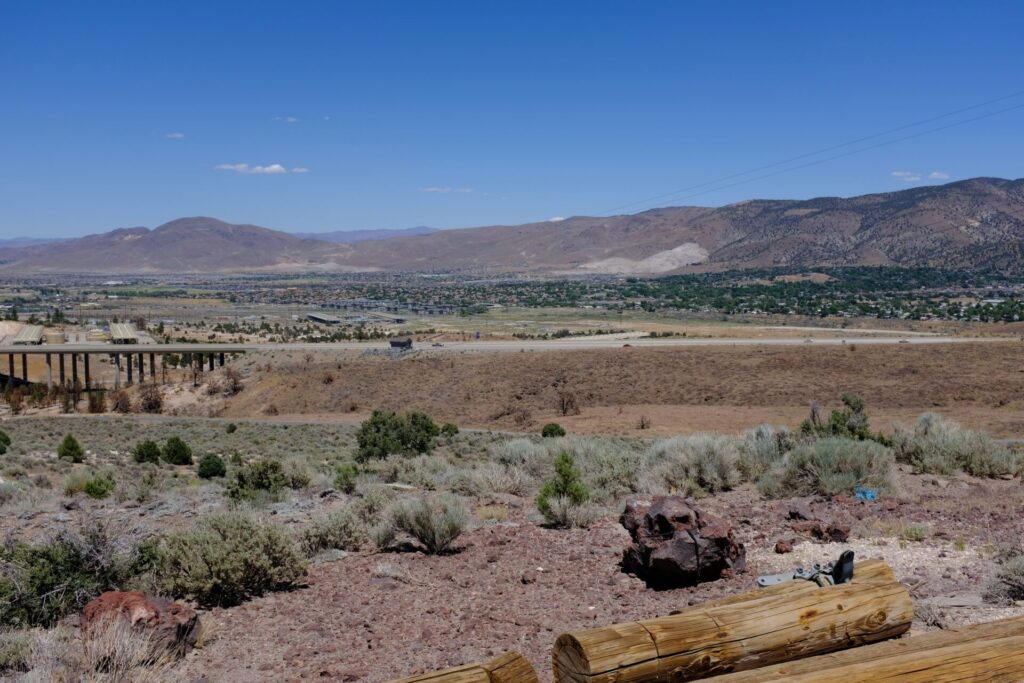
Outside Reno, Nevada. (Photo: Jessica McKenzie)
The view from Reno, Nevada. Elizabeth Leger is a biologist at the University of Nevada, Reno, who studies native plant restoration and post-fire recovery. When she first started at the university in 2006, Forest Service scientists from the research station in Reno took her on field trips to give her the lay of the land—to show her where they had worked and the changes they were seeing—and shared the biggest problems and issues facing public lands in the region, which helped shape her own research questions. Now that research station is on the list of closures.
“The reason why I love these Forest Service research stations is because they have the capacity to look at change over long timescales, the timescales that it actually takes for plant communities to change,” Leger said.
A five-year project is a really long project for me, but that’s nothing for a plant, especially a tree in the desert.
The Forest Service is uniquely positioned to conduct research over decades. Some of their projects have been going since the 1900s, she said. “They plant trees, and they monitor them for literally 100 years,” Leger said. “That’s not something that anyone else can step in and do. It has to be the federal government supporting that.” Through such long-term monitoring, researchers can study how to help ecosystems recover from logging, grazing, or agriculture; how to best protect watersheds; how forests and shrublands respond to climate change, and more.
Leger has worked with nearly a dozen Forest Service researchers over the past 20 years, but she says the research station is down to just two permanent employees after two people left last year.
Rosa Kirk-Davidoff was one of staff members to resign from her job as a biological science technician the second time the agency offered the deferred resignation program. She has continued to collaborate closely with Forest Service researchers as a master’s student at the University of Nevada, Reno, working with them virtually every day.
For her thesis project, Kirk-Davidoff has been studying the post-fire regeneration of Jeffrey pine seedlings. In 2021, the Tamarack Fire burned nearly 70,000 acres in California and Nevada and forced nearly 2,500 people to evacuate. She’s been working with the Forest Service to research the most effective ways to replant trees in the Humboldt-Toiyabe National Forest.
“Even though this is technically only affecting the research station branch instead of the National Forest branch, if the [National] Forest loses the research station, they’re also losing that information about how best to do their management,” she said.
The Forest Service researchers based in Reno also study shrublands in Nevada. “People in Nevada don’t know that the reason we can open our front door in the morning and not be hit in the face with a cloud of dust is because there are plants out there on the shrublands and rangelands,” Leger said.
And the job of the Forest Service is to figure out how to nudge these communities in ways that makes them more beneficial for us.
The service has experimental plots where they study different types of grazing systems and invasive species control. If any of this work continues after the Reno station closes, Leger says it will be at much greater expense to taxpayers. Instead of relying on local researchers, the Forest Service will have to pay for travel and lodging.
Then there’s the loss of the facility itself, which includes a greenhouse, without which it will be hard to start seedlings for replanting.
The outlook in Hilo, Hawaii. Although the tropical forests of Hawaii may not be the first thing to come to mind when one thinks about the Forest Service, the agency has been conducting research there since 1957—work that has only become more urgent in recent years, as the islands battle fires, floods, and invasive species.
The ohia tree, a flowering evergreen that makes up around 90 percent of Hawaii’s tree canopy, has been besieged by a fungal disease that causes rapid ohia death, threatening to wipe out vast swaths of native forest. Native plant species are rapidly being replaced by nonnatives like strawberry guava—a water hog that sucks up groundwater resources. In more arid regions of the islands, invasive grasses spread rapidly during the wet season and then dry out, creating more fuel for devastating wildfires like the one in Lahaina in 2023.
The Institute of Pacific Islands Forestry has been working on all these issues and more. Closing the station will have enormous ramifications for local communities who depend on that research to protect the islands’ watersheds, prevent wildfires, and conserve the native forests for wildlife and the tourism economy.
Rebecca Ostertag is a forest ecologist at the University of Hawaii, Hilo. She’s been at the university since 2001 and has worked closely with Forest Service researchers at the Institute of Pacific Islands Forestry for the past 25 years. She says close to 90 percent of the work she’s done wouldn’t have been possible without them. “They’re my family,” she said.
The Institute of Pacific Islands Forestry is located on the university campus and is a hub for a wide range of environmental research and community outreach. The complex includes laboratory space and a greenhouse, and also houses the Fish and Wildlife Service’s office for the Hakalau Forest National Wildlife Refuge, and the office of the National Science Foundation’s National Ecological Observatory Network, which monitors ecosystems across the United States. It is also the headquarters for the Hawaii Experimental Tropical Forest, which is part of the Forest Service’s network of long-term experimental areas. “Hawaii is quite different than other states, and because we’re so small, all of these agencies work together,” Ostertag said.
If they lost the building, it would be extremely disruptive for many people.
Ostertag estimates that nine people have already left the institute over the past year. “They lost their facilities manager, so the director was coming in on weekends to mow the lawn,” she said.
Rapid ohia death is just one example of how quickly threats to forests can emerge. First reported in 2010, the disease quickly spread, leaving hundreds of thousands of ohia trees dead in its wake. It was identified as a fungus in 2014, but research into how it spreads and how to protect against it is still ongoing.
“Forest Service research has revealed that it tends to be attacking larger, older trees, which is unfortunate because it means our old growth forests are the areas predominantly hit by this,” said Jonathan Price, a geographer at the University of Hawaii, Hilo. Trees that have been damaged by storms, or by feral pigs, or by beetles boring into the wood, seem to be most susceptible.
Ostertag said researchers are studying the genetic diversity of the fungal pathogen and developing disease-resistant strains of trees—all long-term projects that require specialized laboratories and greenhouse space.
And problems in the forest don’t stay in the forest. “If I was talking about our tourism economy, I suppose I could be cynical and say tourists are at the beach, and this has nothing to do with them,” said Price. “But you can go to the beach in Florida, you can go to the beach in California. They’re here for a variety of things, and part of that is to go to our national parks.” The same national parks that are being hit hard by this fungal disease and are at risk of losing their forests.
“When you have a watershed made up mostly of a single native tree species and that species starts dying off, this has implications for flooding, it has implications for water resources,” Price added.
I can’t underscore how unique our situation is, and maybe a little bit out of the public view. People come here—they see paradise. They see these beautiful, lush, green forests without realizing they’re almost entirely made of invasive species, or they hear these beautiful birds without realizing that they’re not even native to this area. And there’s this silent extinction crisis going on that may not be evident to the general public.
Everywhere else. These are specific examples from two research labs in two states, but at least nine regional offices and 55 other research facilities are also going to be closed, directly affecting nearly 200 million acres of land and roughly 30,000 Forest Service employees, but indirectly having a negative influence on countless university professors, students, and other federal agencies.
“We’re not finished learning about how to manage public lands, and this action, it kind of indicates that we’re done learning,” said Leger.
It’s just madness to me that we would decide that we’ve learned everything and shut these places down.
Jessica McKenzie is an associate editor at the Bulletin of the Atomic Scientists. Her work has been published in The New York Times, National Geographic, Audubon Magazine, Backpacker, The Counter, and Grist, among other publications, and has won awards or honorable mentions from the Society for Advanced Business Editing and Writing, the North American Agricultural Journalists Writing Awards, and The Newswomen’s Club of New York. In 2018, she completed the Lede Program for Data Journalism at Columbia University. Previously, she was the managing editor of the civic tech news site Civicist, and interned at The Nation magazine. Outside of work, Jessica is a backyard gardener, a very slow runner, and an enthusiastic backpacker. She has thru-hiked three long trails to date: Vermont’s Long Trail, the Northville-Placid Trail in New York, and the Cohos Trail in New Hampshire.