
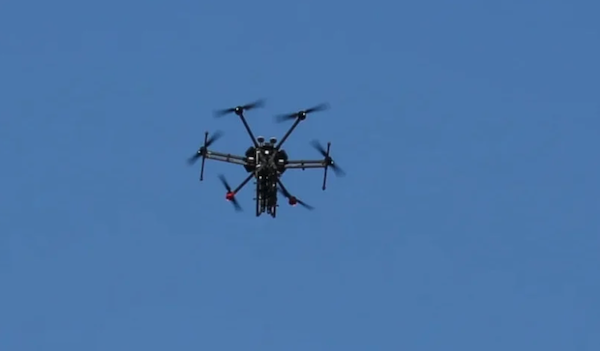
A tiny insect-like robot may appear harmless, but research at Carnegie Mellon University has contributed to the development of cockroach-like robots for the Israeli military, an investigation published by Responsible Statecraft has revealed. The project is part of a broader network of U.S. university research linked to the Israeli military, raising questions about how academic science is being harnessed for military purposes.
Robotic cockroaches, “terror-network” mapping, and rapid missile guidance are among at least 70 research projects conducted by U.S. universities for the Israeli Ministry of Security. More than 1,000 pages of internal university and U.S. and Israeli military documents show evidence of a broad, decades-long program funding military research partnerships with at least 30 U.S. universities, ranging from Cornell to the University of California at San Diego, dating back to at least 2009.
Some of the projects have been conducted jointly with the Israeli military and have explicitly incorporated environmental conditions in Palestine. One project developed fuel cells for “distributed sensor networks,” adapting them to the temperature and soil conditions along a border in an Israeli-occupied area. The system was intended to monitor “potential terrorist activity” as part of “border security.”
Recent investigations by Dropsite News, The Nation, and the Anti-War Initiative have documented millions of dollars in Israeli military funding flowing to U.S. universities. Public records from 13 U.S. universities show that the money was distributed through a U.S. arms-export program supporting collaborations between Israeli scientists and military officials.
Military contracts rather than academic grants
The projects do not operate through conventional academic grant programs. Instead, they are classified as “defense articles and services” and financed with U.S. taxpayer funds through the Foreign Military Financing (FMF) program, the same mechanism “Israel” uses to acquire F-35 fighter jets and other U.S. defense exports.
At least 11 contracts brought U.S. scientists to “Israel” to work directly with counterparts at Israeli universities and/or the Israeli Ministry of Security. The agreements allocated money for U.S. professors to attend meetings and present their research to the Israeli Ministry.
The research
The subjects covered by the research reflect a wide range of Israeli military interests, including drone swarms, missile guidance, fuel cells, and quantum sensing. Several projects illustrate the ways U.S. universities have contributed to Israeli military research efforts.
At the University of Maryland, Prof. Sarah Bergbreiter worked with an Israeli Ministry of Security scientist to develop “[inchworm-like]” crawlers, alongside research into robotic cockroaches. Maryland professor Indejrit Chopra and Brown University professor Kenneth Breuer drew inspiration from hummingbirds and bats to develop micro-drones capable of searching caves and destroyed buildings. At Columbia University, Prof. Hod Lipson developed the Flexipod, a “soft quadrupedal robot” designed to move across varied terrain and perform backflips.
The Israeli occupation forces have also used other drones to gather extensive surveillance datasets, which are then supplied to AI systems designed to track targets and speed up “[kill-chains]”. Recent Israeli advances in this field follow years of funded research by the Israeli Security Ministry at U.S. universities into related technologies.
Prototype AI system
In December 2016, the Israeli occupation forces developed a prototype AI system that could “Tell You What’s Happening in a Video,” producing captions intended to help soldiers “keep an eye on the battlefield.”
A year later, Prof. Kate Saenko received $120,000 from the IMoD to study “Generating Natural Language Descriptions for Video,” using AI to automatically identify and describe people and objects appearing in video. A second IMoD contract funded work on “Zero Shot Captioning,” which uses machine learning to describe previously unseen objects. Saenko’s research group later presented software for the “detection of novel objects” under the title “Learning To Detect Every Thing” at a conference in Tel Aviv.
According to an ex-IOF intelligence officer, a human eye “will go over [AI-generated] targets before each attack, but it need not spend a lot of time on them.” An Israeli Ministry of Security-funded project at the University of California, Berkeley, could further accelerate that process.
Neuroscientist Robert Knight tested electrodes in a brain-computer-interface (BCI) intended for “cognitive enhancement” during “high throughput tasks requiring visual recognition.” In an internal proposal submitted to the Israeli Ministry of Security, Knight also discussed possible uses such as “detecting ‘suspicious’ activity.” Those applications, however, did not appear in his published study.
Algorithms in the hands of the IOF
At the University of Maryland, Prof. V.S. Subrahmanian received Israeli Ministry of Security funding for research titled “Targeting of Terror Networks,” with the stated goal of finding “weak points for the destabilization of terrorist networks.” He later applied the algorithms to social media to identify alleged “sympathizers” of Hezbollah.
Another Israeli Ministry of Security contract awarded to Subrahmanian, titled “Massive Social Networks,” examined “1.04 million person-days” of cellular location data to study population movements in “Israel” and the occupied Palestinian territories. The research noted that its algorithms were “related to… monitoring for evading targets by a flock of unmanned air vehicles.”
Other IMoD-backed research focused directly on drone swarms.
“Human-Robot Interaction Design for a Single Operator with Many Robots” was the title of an IMoD project led by Prof. Holly Yanco, director of the University of Massachusetts Lowell’s Robotics Center. MIT professor Emilio Frazzoli developed “trajectory optimization” algorithms for groups of quadrotors, stressing that his findings were “easy to implement and may be used directly.”
‘Package delivery UAVs’
At the University of Michigan, Prof. Joaquim Martins worked with the Israeli Ministry of Security to optimize fleets of “package delivery UAVs” according to “mission requirements” involving different package weights and delivery distances.
His research concluded that quadrotors were best suited to “long-range missions with small numbers of customers.” Martins also thanked Rafael, the Israeli arms company, and its CTO of Multi-Domain Warfare for assistance with “research methodology”.
Despite the Israeli Ministry of Security sponsorship, Martins’ published paper described only civilian applications, including the use of drones to deliver “medical supplies”.
Differences between proposals and published research
The Michigan project is not the only apparent instance in which the military applications described in an Israeli Ministry of Security proposal differed from those identified in the resulting public paper.
In 2015, University of Illinois Chicago professor Alexander Yarin and Technion professor Eyal Zussman submitted a proposal for chemical sensing research. Their application told the Israeli Ministry of Security that their “overall research objective is to develop [a] fundamental understanding of sampling and detect[ing] buried explosives,” adding that “the detection of buried improvised explosives and mines [is] a major challenge in the battlefield.”
The public paper that followed described experiments that were nearly identical to those in the internal application, but listed civilian uses such as “mining”, It contained no references to “explosives” or the “battlefield” and did not disclose funding sources, including the Israeli Ministry of Security.
Neither professor responded to a request for comment, as per the report.
The funding pipeline
The research is purchased through the Israeli Ministry of Security’s Mission to the USA, the Israeli military procurement office responsible for spending roughly $3.3 billion in annual U.S. aid on defense goods and services.
As analyst Christian Sorensen of Eisenhower Media Network explained over e-mail, “US taxpayers give money to the U.S. government. The U.S. government then sends billions of dollars to Israel. Israel uses that money, there’s not a strict accounting, to purchase goods and services from U.S. war corporations and research from U.S. academic institutions.”
Universities receiving Israeli Ministry of Security funding, including UC Irvine, certified that they were “entering into an agreement to sell defense articles … to the foreign government listed above,” with payments made “under the provisions of the Arms Export Control Act.”
The projects are classified as Direct Commercial Contracts (DCCs), meaning sales by a defense contractor to a foreign military that are subsidized by the U.S. government. Because only DCCs worth more than $100 million to “Israel” require notification to Congress, the program has no public reporting system or detailed congressional oversight. It is therefore unknown whether other countries also use DCCs to sponsor research at U.S. universities.
One university administrator described the funding arrangement in an e-mail to the Israeli Ministry of Security as a “departure from standard process.”
Israeli defense funding loophole expands under U.S. export rules
For more than 35 years, “Israel” was among only 10 entities authorized to use DCCs, spending more than a billion dollars each year on defense exports from private entities, including research projects of this kind. In April 2026, however, the Pentagon expanded the privilege to more than 50 countries.
A bureaucratic exception known as the Fundamental Research Exclusion allows the Israeli Ministry of Security to circumvent export controls on defense research it sponsors when the resulting work is ultimately “published and shared broadly.”
University records and public scrutiny
Both MIT and the University of California systems censored their funding databases after student activists uncovered Israeli Ministry of Security contracts involving their institutions.
In July 2025, an MIT professor canceled a proposed Israeli Ministry of Security contract following public backlash.
When asked about the purchasing arrangement, a State Department spokesperson directed questions to a fact sheet on U.S.-Israeli Security Cooperation. The document states that the United States participates in “a variety of exchanges with Israel,” including research and weapons development.
The Israeli Ministry of Security declined to comment, as per the report.