
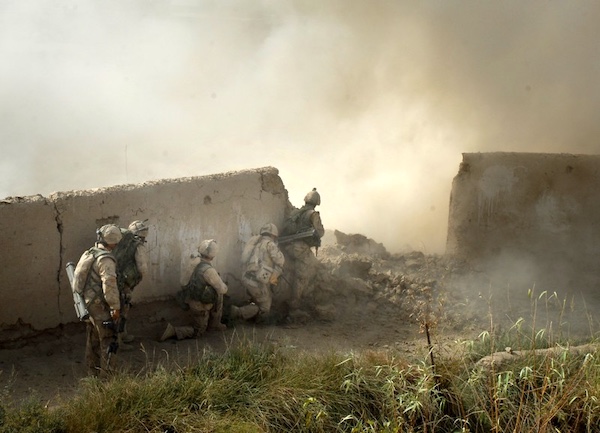
My innocent children have been killed by foreigners—for no reason!
This was the traumatized cry of an Afghan mother whose children, aged two and four, were shot dead by Canadian soldiers before her eyes in 2008. Commenting on this tragedy, Canadian Defence Minister Peter MacKay used the passive voice to describe the killing of the children, stating that “two Afghan children… were killed in this incident” and expressing sadness at the “horrible decision that had to be taken” by the toddlers’ killers. MacKay placed no blame on Canadian soldiers, instead blaming the children’s deaths on “the despicable tactics used by the Taliban, hiding among the civilian population.”
Nobody in government or the mainstream media seemed to care that, if Canadian soldiers hadn’t been deployed to Afghanistan, those small children might not have died.
Three days ago, on the 25th anniversary of 9/11, former Prime Minister Jean Chrétien sent a message to “our American friends,” who have been threatening to annex Canada for the past year and a half. “Never mistake our generosity for weakness,” he told the Trump administration. “We bow to no one.” Meanwhile, a pair of articles published in the Globe and Mail sought to refute Trump’s claim that Canadian and other NATO countries’ troops “stayed a little back, a little off the front lines” during the war in Afghanistan. The pieces quoted Canadian soldiers who were personally involved in offensive missions against anti-occupation forces.
The first article, by reporter Kyle Duggan, describes challenges faced by Canadian soldiers deployed to aid the invasion, such as equipment shortfalls, lack of helicopters, and insufficient personnel. The second piece, by reporter Tu Thanh Ha, explains the Canadian military’s role in Operation Medusa, a NATO offensive in the Panjwayi district of Kandahar Province. Although NATO’s casualty numbers paled in comparison to those on the other side (hundreds of Taliban soldiers were killed in the fighting), Canada lost 12 troops in the operation.
These Globe and Mail reports ignore the impact that Canada’s role in the U.S.-led war on Afghanistan had on Afghans themselves. As I describe in my 2023 book Canada in Afghanistan, this impact was decidedly negative.
After the attacks of September 11, 2001, Canada deployed 40,000 military personnel to support the U.S. attack on Afghanistan. Canada was eager to aid the assault. According to U.S. Ambassador Paul Cellucci, Canada’s then Defence Minister Art Eggleton was “begging” to join the U.S. operation. Cellucci recalled: “I got a call on my cell phone from Art Eggleton during the buildup in Afghanistan. The message was ‘We want to be part of this.’” Over the course of the 12-year mission, 159 Canadian troops would lose their lives.
During the occupation of Afghanistan, Canadian special forces claimed that their commanders “encouraged” them to commit war crimes. Canadian soldiers rounded up Afghans and handed them over to the police to be tortured (in December 2009, Prime Minister Stephen Harper prorogued Parliament to put an end to the investigation of Canadian complicity in the torture of Afghan detainees).
Canadian forces functioned as an occupying army and behaved as such, operating checkpoints and participating in no-knock raids and arrests. Canada supported rigged elections aimed at keeping U.S. ally Hamid Karzai in power. The military imposed strict censorship on embedded journalists. On top of this, the Canadian government established the so-called “Tiger Team” to black out access-to-information requests and thus prevent the Canadian public from learning more about the military’s conduct in Afghanistan.
Between 2006 and 2009, Canadian troops killed at least eleven innocent people driving civilian vehicles at checkpoints. All these actions contributed to anti-Canadian protests in Kandahar Province, during which Afghans angry at the aggressive and unaccountable behaviour of occupation forces chanted “Death to Canada.”
Paul Demetrick, a corporal who participated in Operation Medusa, accused Canadian soldiers of “indiscriminate bombing and shelling of villages, killing innocent men, women and children.” He wrote:
We fire white phosphorous shells (a chemical weapon outlawed by the Geneva Conventions due to the horrific way it burns human beings) into vineyards where it was known Afghan insurgents were deployed; we hand over prisoners of war to Afghan authorities, who torture them; and we shoot and kill a two-year-old Afghan boy and his four-year-old sister. Do we want to be remembered for hating, killing and destroying, or caring, healing and helping with reconstruction?
Canada’s Afghanistan deployment was not a humanitarian or reconstruction mission. Ottawa’s motives were geopolitical and self-interested. Canadian economic advisors in the Strategic Advisory Team—Afghanistan (SAT-A) encouraged the Karzai government to privatize resources and reduce the role of the state in the economy, an economic orientation from which Canadian companies benefitted—namely, SNC-Lavalin, SRK Consulting, Canaccord Financial, and Lockheed Martin Canada. During the occupation, the largest iron mine in Afghanistan, the Hajigak deposit, was purchased by Canadian company Kilo Goldmines. Government officials flew to Turkmenistan alongside Canadian oil and gas representatives to lobby for the Turkmenistan-Afghanistan-Pakistan-India (TAPI) pipeline, which was aimed at countering Russian, Iranian, and Chinese influence in the region. Defence Minister Peter MacKay stated that Canadian soldiers in Kandahar Province were “not there specifically to protect a pipeline across Afghanistan” but “if the Taliban were attacking certain places in the country or certain projects, then yes, we will play a role.”
Meanwhile, the promised benefits of the Canadian occupation—the rehabilitation of the Dahla Dam, the building of 50 schools, and a $60 million program to vaccinate children against polio—never came. The Dahla Dam was not restored. Polio was not eradicated. Many of the Canadian schools were more expensive than planned, poorly attended, or entirely unused. Recalling his time reporting from Afghanistan, military journalist Scott Taylor wrote that “embedded Canadian journalists would be escorted to numerous… ribbon-cutting ceremonies—usually a new schoolhouse with Afghan girls positioned in the front row for maximum propaganda impact in the photo-op.” However, when he returned with an unembedded film crew, he discovered something much different:
What we found at the school was the principal and a couple of his cronies playing cards and drinking tea. Although there were four thousand students registered and it was a school day, not a single student was on the premises. The reason for this was that all the teachers had left to join the Afghan army or work for foreign military forces as interpreters, where they could earn three times a teacher’s salary.
According to the Canadian Press, Canada pushed ahead with ambitious, eye-catching, and ultimately unachievable projects despite the fact that Afghans themselves were asking for more basic services like “stable electricity sources, paved roads and jobs.”
Ultimately, the Ottawa spent $18.5 billion on the occupation of Afghanistan. While the Canadian military-industrial complex and some transnational companies benefitted, the Afghan people certainly did not.
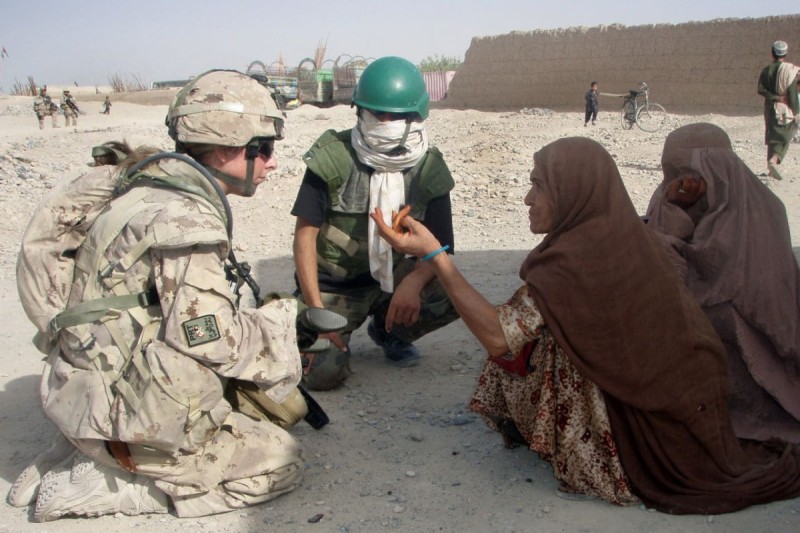
A Canadian soldier and an interpreter from the Kandahar Provincial Reconstruction Team speak with an Afghan woman from the village of Panjwayi in Afghanistan in 2007. (Photo: Cpl. Simon Duchesne)
Humber College professor Tyler Shipley offers the following assessment of the war in Afghanistan and Canada’s role in it:
[W]hile the war brought windfall profits to a range of Canadian companies, its aims were broader than simply to bulge the pockets of Canadian millionaires. The war in Afghanistan—like that in Iraq—was about establishing the architecture of the American empire in the 21st century. U.S. capital needed a world in which resistance was defeated and demoralized, where local client states could be counted upon to maintain the legal and political conditions ideal for exploitation of labour and resources and where there was a multi-level security apparatus to protect the flow of profits from any possible threats… Canada’s significant contribution to the war in Afghanistan was to signal to Washington that Canada would ‘play ball,’ sacrificing resources, reputation and working-class lives to maintain the integrity and functionality of the U.S. empire. The payoff for Canada was that it would continue to receive preferential treatment within the empire; this included access to contracts, the sharing of information and a seat at the table where the big decisions would be made. Its participation in wars like Afghanistan was designed to be leveraged for those advantages.
Canada’s participation in the invasion and occupation of Afghanistan, and the broader “War on Terror,” is nothing to celebrate. In addition to Afghanistan, Canada aided the flagrantly illegal U.S. invasion of Iraq—a country that had nothing to do with 9/11—and well-connected Canadian companies like SNC-Lavalin and Nortel profited from the war. In 2011, Canada helped the U.S. destroy Libya, which, in addition to being the most prosperous country in Africa, also had no connection to the 9/11 attacks.
According to Brown University’s Costs of War project, the post-9/11 U.S. wars killed at least 4.5 million people and displaced 38 million more. Canada participated in many of these attacks. Economically and geopolitically aligned with an emboldened U.S. empire, Canada chose to assist and benefit from the imperialist destabilization of an entire region, contributing to millions of deaths. This deserves condemnation, not commemoration.
In February 2022, six months after the Taliban retook Kabul, the Biden administration seized $7 billion in Afghan central bank reserves, depriving the government of much-needed funds as it attempted to rebuild after decades of war. As one million children faced starvation, Canada contributed to the rising malnutrition by preventing food and medical aid from entering the country. The federal government threatened aid workers with criminal prosecution for bringing aid to Afghans—the very people Ottawa had claimed to be protecting during the occupation. These restrictions remained in place for years. In April 2024, head of the Afghan Women’s Organization Asma Faiza told Global News that Canadian aid organizations were “ready, willing and able to work” in Afghanistan, but they were “prohibited” from doing so by the federal government.
None of the top officials who oversaw Canada’s Afghanistan mission have faced consequences resulting from the mission’s calamitous human impact.
Canadian general Rick Hillier, who led the multinational force in Kabul and later served as Canada’s chief of defence staff, proudly proclaimed that his job in Afghanistan was to “kill people”—he subsequently received positions at Telus, TD Bank, and Provincial Aerospace. Last month, National Bank of Canada chose Hillier to serve as its strategic defence advisor. In that role, he will “assist with National Bank’s efforts to grow its client base in the defence and security industry.”
Chris Alexander served as Canada’s ambassador to Afghanistan from 2003 to 2005. In his autobiography, Alexander wrote of his dream to turn Afghanistan into the new Azerbaijan—a Western-backed oil dictatorship. As ambassador, Alexander advised President Hamid Karzai on the creation of a new constitution. He recommended that Karzai appoint Sibghatullah Mojaddedi, a former mujahideen fighter who had briefly served as president in 1992, to lead the 35-member constitutional commission. After Afghan activist Malalai Joya denounced the constitutional council as “the most anti-women people in [Afghan] society,” Mojaddedi called Joya a “Communist” and an “infidel.” By doing so, he effectively endorsed her execution, as blasphemy in Afghanistan was and remains punishable by death. Neither Alexander nor Ottawa denounced Mojaddedi’s statement.
In 2013, Alexander was named Prime Minister Stephen Harper’s minister of citizenship and immigration. Eleven years later, Alexander appeared before Canada’s national security committee to spread false claims that journalist David Pugliese was spying for the Russian government. One cannot help but note that Pugliese is one of the only journalists in the mainstream who regularly reports on Canadian military scandals.
Bill Graham was Prime Minister Jean Chrétien’s Minister of Foreign Affairs from 2002 to 2004 and Minister of National Defence from 2004 to 2006. After retiring from politics, he served as “Chair of the Atlantic Council of Canada (now the NATO Council of Canada), Co-Chair of the Canadian International Council, Honorary Colonel of the Governor General’s Horse Guards, and Chancellor of Trinity College in the University of Toronto.” In Afghanistan, Graham oversaw the creation of the SAT-A under Rick Hillier’s direction. The SAT-A advised the Karzai government on its Afghan National Development Strategy (ANDS), which placed foreign investment and privatization at the heart of Afghanistan’s new economic policies.
Jean Chrétien, the prime minister who oversaw Canada’s entry into the war, flew to Turkmenistan multiple times to lobby for Canadian investment in the country’s oil sector. Had Canadian forces been able to secure Kandahar Province for the construction of the TAPI pipeline, Canadian oil and gas companies would have profited enormously.
In 2003, Chrétien told the House of Commons that Canada would not participate in the illegal invasion of Iraq; however, on that same day, top Canadian diplomats promised British and U.S. officials that Canada would help. A WikiLeaks cable released in early 2011 reads:
While for domestic political reasons… the GOC [Government of Canada] has decided not to join in a U.S. coalition of the willing… they are also prepared to be as helpful as possible in the military margins… Despite public statements that the Canadian assets in the Straits of Hormuz will remain in the region exclusively to support Enduring Freedom [the invasion of Afghanistan], they will also be available to provide escort services in the Straits and will otherwise be discreetly useful to the military effort [in Iraq]…
Chrétien later revealed that he had told U.S. President Bill Clinton: “Mr. President, I don’t want to be too close to you, because I don’t want to look like we are the 51st state of America… If I am independent enough I might do a lot of things that will be very useful to you, that the CIA cannot do.” Chrétien claimed that he told George W. Bush the same thing. “We are so close to America,” Chrétien added.
When you do 85 percent of your trade with the Americans, you have to be very close.
For the past year and a half, the Carney government has claimed that it is standing up to Trump’s bullying. Yet our government and media continue to celebrate Canadian complicity in U.S.-led imperialist wars. We can’t have it both ways. Canada cannot defend its sovereignty from a belligerent U.S. without properly identifying the destructive role that the U.S. plays in the world, recognizing Canada’s past and present involvement in such policies, holding those responsible accountable, and breaking with U.S.-dominated military structures like NATO and NORAD. So far, Canada has done the opposite, massively increasing military spending at the Trump administration’s behest while supporting illegal U.S. attacks on Venezuela and Iran.
Our government and media have taken the wrong lessons from Canada’s role in the Afghanistan war. We cannot simultaneously demand that our sovereignty be respected while celebrating our role in the occupation of another sovereign country—an occupation that saw Canadian troops bomb civilians, kill children, deliver Afghans to torture chambers, and shape Afghan economic policy to benefit Canadian companies.