
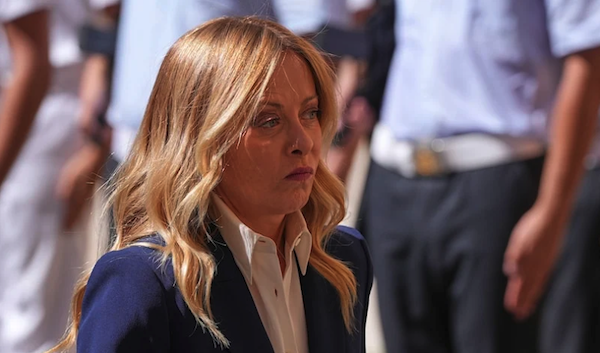
Italian Prime Minister Giorgia Meloni announced Sunday that her government will move to ban burqas and niqabs in schools, cap the number of foreign students allowed in a single classroom, and require parents of foreign students struggling to integrate to learn Italian.
Meloni delivered the announcement to the youth wing of her far-right Brothers of Italy party, framing the measures as an integration push, ahead of a general election due by December 2027.
https://x.com/clashreport/status/2101643699922878491?ref_src=twsrc%5Etfw%7Ctwcamp%5Etweetembed%7Ctwterm%5E2101643699922878491%7Ctwgr%5Efb5cedec2697acbd2832b4eaa43c373431ccec89%7Ctwcon%5Es1_&ref_url=https%3A%2F%2Fenglish.almayadeen.net%2Fnews%2Fpolitics%2Fitaly-moves-to-ban-burqas-cap-foreign-students-in-schools
Italy currently has no law that explicitly bans the burqa or niqab. A 1975 law prohibits helmets or garments that obscure identification without justified reason, and a 2008 ruling by Italy’s highest administrative court found that full-face veils may be worn for religious or cultural reasons, provided the wearer’s face can be shown when identity verification is required.
The anti-immigrant League, Meloni’s coalition partner, has a bill before the Senate that would restrict face-covering garments except in specific circumstances such as sporting events or places of worship.
On the classroom quota, Italian law has capped foreign enrollment at 30 percent of a class or school since 2010, a threshold that can be raised for students with strong Italian or lowered for those without it. Meloni did not specify how the existing quota would be altered.
A push from further right
The school crackdown was first called for in July by National Future, a party further right than Meloni’s own and not part of her governing coalition, which has surged in the polls since its founding in February.
That surge is part of a larger squeeze on Meloni’s right flank. Her coalition partner Lega has collapsed to roughly 6 percent support, down sharply from previous highs, as voters defect to National Future’s Roberto Vannacci.
The pressure comes at a fragile moment for the government, which lost a constitutional referendum in March, its first major electoral setback, and saw a fall 2025 round of regional elections end in a dead heat with the center-left.
Recent polling aggregates put the center-left bloc roughly level with Meloni’s coalition heading toward 2027.
A policy aimed at a small minority
Muslims make up an estimated 4.6 percent of Italy’s population, a figure that has climbed gradually over the past decade but remains far below public perception.
Surveys have found Italians guess the Muslim share of their population at closer to 20 percent, one of the widest gaps recorded anywhere in Europe.
Foreign residents overall account for roughly 9.1 to 9.4 percent of Italy’s population under the most recent national statistics, while foreign students make up just under 12 percent of school enrollment, a difference largely explained by younger average ages among immigrant families.
France became the first European country to impose a nationwide public ban on full-face coverings in 2011, and Belgium followed the same year. Bulgaria, Austria and Denmark enacted their own bans over the following decade, and Portugal became the most recent addition in August, when President Antonio Jose Seguro signed a bill passed by parliament the previous month. Switzerland’s ban, approved by referendum in 2021, only took effect at the start of 2025.