
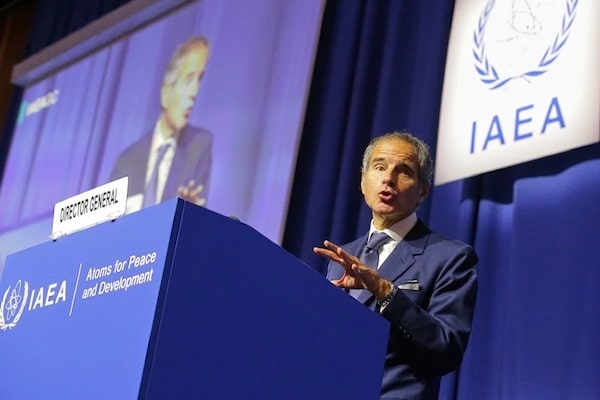
Iranian nuclear chief Mohammad Eslami said the International Atomic Energy Agency (IAEA) has conducted multiple inspections in Iran without producing a report documenting any case of non-compliance.
Eslami, who heads the Atomic Energy Organization of Iran, said there is “not a single report on a case of non-compliance,” stressing that the IAEA had access to all facilities.
Eslami pointed to the agency’s inspections in Iran, saying its repeated access to Iranian facilities had not resulted in any report identifying a case of non-compliance.
He also addressed doubts surrounding Iran’s nuclear activities, saying disbelief stems from the agency’s objective of stopping Iran’s progress.
Iranian nuclear chief says IAEA had access to facilities
Eslami emphasized that the IAEA had access to all Iranian facilities, linking the agency’s inspections to Iran’s position that its nuclear activities have been subject to international monitoring.
According to Bloomberg, Iran secured a diplomatic gain at the IAEA this week by obtaining a seat on the agency’s regulatory committee despite U.S. opposition.
The development follows an earlier selection by West Asian countries of Iran for membership in the body responsible for organizing the IAEA conference, a move that also prompted opposition from the United States.
Iran says nuclear program will continue
Iranian Atomic Energy Organization (AEOI) spokesperson Behrouz Kamalvandi said Tuesday that Iran’s nuclear program would not be halted by external pressure, military attacks, or acts of sabotage, stressing that Tehran’s activities remain peaceful.
Speaking during the 70th General Conference of the International Atomic Energy Agency (IAEA), Kamalvandi said Iran “will not surrender” and reiterated that the country’s nuclear program is aimed at civilian purposes and pursued within the framework of its rights under international agreements.
He argued that attempts to damage Iran’s nuclear infrastructure through military strikes, sabotage, or assassinations would not eliminate the country’s scientific capabilities or nuclear expertise.
“Military attacks, sabotage and assassinations cannot eliminate Iran’s nuclear knowledge and industry,” Kamalvandi said.
Iran rejects claims of hidden nuclear activity
Addressing concerns over Iran’s underground nuclear facilities, the AEOI spokesperson said the location of sensitive sites in protected areas does not mean they were concealed from international oversight.
“Locating nuclear facilities in safe and appropriate places does not mean concealing or hiding them,” he said.
Kamalvandi stressed that despite being underground, Iran’s sensitive nuclear facilities had remained subject to International Atomic Energy Agency (IAEA) inspections, adding that inspectors had been present at those sites.
He said Iran’s decision to fortify and protect key facilities was a natural response to years of military and security threats against the country.
“Iran has long faced continuous military and security threats, and it is natural that it fortifies its vital facilities against potential enemy attacks,” he said.