
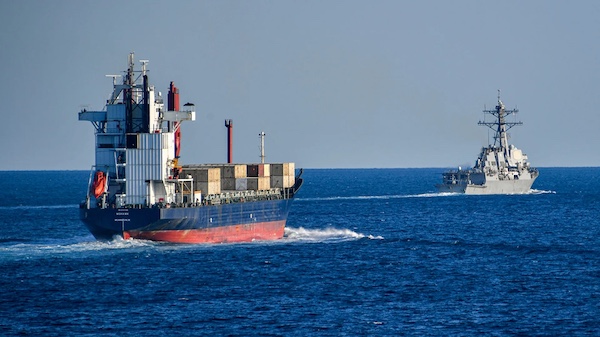
The war against Iran, following the armed assault on Venezuela, is part of a strategy of U.S. imperialism to recolonize the Global South as a means of overcoming the twin crisis it currently faces: one is a stagnation of its economy, together with that of the world economy in general as a consequence of the pursuit of neoliberalism; the other is the persistent current account deficit of the U.S. ever since the mid-1970s, which has made it the world’s most indebted nation and poses a threat to the hegemony of the dollar. Recolonization, in the sense of forcibly capturing the markets of the Global South and acquiring control over its resources, especially oil, would both reduce the current account deficit of the U.S., thereby strengthening the dollar, and overcome economic stagnation in the U.S., without in any way disrupting the hegemony of international finance capital. The war on Iran thus presages an assault on the Global South.
I
The U.S.—Israeli war against Iran is often attributed to Donald Trump’s imbecile or unbalanced character; but this is an utterly superficial view. What Trump is attempting is a strategy of revival from the crisis that U.S. imperialism currently faces; and the war against Iran is a part of that strategy. This crisis has two aspects: one is the crisis of stagnation and increased unemployment that neoliberal capitalism has unleashed on the entire world economy, including upon the U.S. economy. The other is the persistent current account deficit that the U.S. has been running since the mid-1970s, which, since it is financed by U.S. exports of dollars or dollar-denominated assets, makes that country the world’s most indebted nation, and poses a serious threat to the entire capitalist world’s financial system. Let us examine each of these aspects.
Neoliberal capitalism has given rise to an immense increase in income and wealth inequality all over the capitalist world. This is because in the neoliberal regime, while capital becomes globalized, labor remains confined within national boundaries and is also organized primarily along national lines. This makes the labor of the Global North compete against the labor of the Global South, in the sense that any widening in the wage difference between the two threatens accelerated relocation of capital from the North to the South. Northern wages therefore get tethered to Southern wages and cannot rise even when labor productivity rises. In fact, Joseph Stiglitz has estimated that the real wage of an average male American worker in 2011 was marginally lower than in 1968!
At the same time, despite all such relocation of activity from the North to the South, since growth in labor productivity accelerates in the South under neoliberalism, the vast labor reserves of the South inherited from the colonial times, which keep Southern wages tied to a subsistence level, do not get depleted as a proportion of the labor force. This keeps Southern wages more or less at the same subsistence level as before. Both in the North and in the South, therefore, the level of real wages scarcely increases, even as labor productivity rises everywhere, which is what gives rise to increased income inequality both at the level of the world economy and within individual capitalist countries.
Since consumption out of a unit of income is larger for the poor than for the rich, an increase in income inequality has the effect of lowering consumption demand, and hence aggregate demand, relative to producible output. Producible output therefore cannot be sold, leading to reduced output and, hence, increased unemployment and stagnation. This has afflicted not only the capitalist world economy as a whole, but also individual countries within it (though in the U.S. the increase in the unemployment rate is camouflaged by a fall in the work participation rate).1 Neoliberal capitalism, however, not only gives rise to a crisis of stagnation and increased unemployment, but also prevents the state from taking any measures to counter this crisis; and it is this that constitutes its specific hallmark. This is because if increased state expenditure were to boost aggregate demand for overcoming stagnation, then it would have to be financed either by a fiscal deficit (where nobody is taxed to raise revenue) or by a tax on the rich (where a part of the tax revenue comes out of savings and therefore does not reduce demand); it cannot be financed by taxes on the poor and working people. Since the poor and the working people consume more or less their entire income, the state’s taxing them and spending the proceeds does not add much to aggregate demand: state demand in this case only substitutes the consumption of the poor tax payers but does not enhance overall demand.
But both the ways of raising revenue for state spending that would make such spending counter the crisis of stagnation—that is, a larger fiscal deficit or more taxes on the rich—are ruled out under neoliberalism, because globalized finance is opposed to both.2 And the state cannot overrule this opposition because, since finance is globalized, it can flow out of the country en masse in the event of any such state intransigence, causing a severe crisis. In other words, the state being a nation-state, and capital, including finance, being globalized, any economy that adopts a neoliberal regime (i.e. accepts relatively free cross-border flows of goods and services, and of finance), would have to accede to the whims and caprices of globalized finance; the nation-state of this country then becomes incapable of intervening in the economy to counter the tendency toward stagnation.
Neoliberalism thus pushes the world economy, and the economies of individual capitalist countries, to a cul-de-sac, where they get mired in stagnation but can do nothing about it; and breaking out of this straitjacket is not possible either, since neoliberalism has the powerful backing of monopoly capital both in the Global North and in the Global South, which are integrated with globally mobile finance capital. Under these circumstances, monopoly capital has been supporting the emergence of neo-fascism to buttress its hegemony which gets threatened owing to the mass unemployment and distress it brings to large sections of the population. There is a neo-fascist upsurge all over the world; in some countries like Argentina, Italy, the U.S., and India, the neo-fascists are in power with the backing of the corporates; in other countries like France, Germany, and the UK, the neo-fascists are knocking on the doors of power. (The neo-fascist Israeli state of course is in a special category of its own, being engaged simultaneously in a ruthless project of settler colonialism.)
These neo-fascist regimes are characterized in varying degrees by several features reminiscent of the fascism of the 1930s: the ‘othering’ of a minority religious or ethnic group and the fomenting of hatred against it within the majority, which both creates an alternative discourse that distracts attention away from the crisis, and also keeps the working people divided; the resort to state repression against political opponents, artists, intellectuals, and the Left; the use of neo-fascist hoodlums alongside state agencies in this process of repression; a close nexus with monopoly capital, and especially with a new stratum of monopoly capital; and the promotion of a cult of the ‘leader’ who is supposed to personify the ‘nation’.
A neo-fascist state, however, cannot resolve the crisis of stagnation that afflicts contemporary capitalism any more than a liberal-bourgeois state can, and for exactly the same reasons. Neo-fascism only takes control over the nation-state that remains as powerless to impose its will against globally mobile finance capital as the liberal bourgeois nation-state had been. Finance’s opposition to taxes on the rich and to fiscal deficits continues to be decisive roadblocks against any expansionary fiscal intervention even by the neo-fascist state. This was not the case in the 1930s when finance capital had been national and hence could be cajoled by the fascist nation-state not to oppose large-scale fiscal deficits. It is with such large fiscal deficits that increased state expenditure on rearmament had been financed in Germany and Japan and had the effect of lifting these countries out of the Great Depression. That situation, however, cannot be repeated today; and hence the cul-de-sac that constitutes the denouement of neoliberalism cannot be overcome by neo-fascism either.
The second aspect of the crisis facing U.S. imperialism, and hence by implication world capitalism, is more simply stated. It arises because of the persistent U.S. current account deficits that have made the U.S. the world’s most indebted country. This is an unprecedented situation: until now the leading capitalist country, whose currency plays the role of being de facto world money, has never had to face persistent current account deficits. This, however, is no longer the case. This unprecedented situation has arisen because the ‘advantage’ of having a colonial empire that had been available to Britain, the earlier leader of the capitalist world, is no longer available to the U.S., the new leader. Britain had covered its current account deficit vis-à-vis the non-colonial world, and even made capital exports to this world, by making use of its colonies. And it had done so in two ways: First, by selling its goods in the captive colonial markets of countries that could not protect themselves and had to face ‘deindustrialization’ in the sense of the displacement of vast numbers of artisans and pre-capitalist producers; and secondly, by extracting a ‘tribute’, or what has been called a ‘drain of wealth’, from the colonies in the form of appropriating without any quid pro quo the export surplus of the colonies vis-à-vis the non-colonial world.
The U.S. has not had these ‘advantages’. While U.S. imperialism has ensured the continued existence of an ‘economic territory’ that sustains metropolitan capitalism in general and U.S. capitalism in particular, by inter alia making inputs available to it at non-increasing prices, this ‘economic territory’, though constituting its empire, is not in the nature of a colony: it neither constitutes a captive market, nor is a source of ‘tribute’. This unprecedented situation, of the leading capitalist country running a persistent current account deficit, has been managed till now because the world has been readily willing to hold on to the dollars or dollar-denominated assets with which the U.S. has been financing its current account deficits. How long it will do so remains, however, a moot point. Whenever this issue is discussed, such discussion remains confined to whether those holding dollars might switch to some other currency; and since no other currency is as yet anywhere close to the dollar in terms of its importance, the threat to the dollar arising from this source does not appear serious. What this discussion misses, however, is the threat to the dollar arising from a possible switch not to some other currency, but to some commodity; and the commodity most likely to pose such a threat is oil.
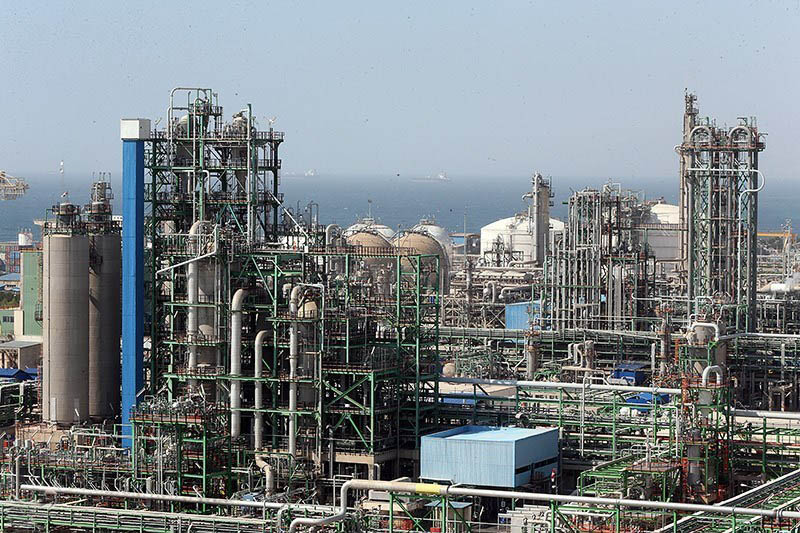
Petrochemical complex in Asaluyeh, Iran. (Photo: Majmood Hosseini / Tasnim News Agency)
The breaking of the gold—dollar link that had been instituted under the Bretton Woods system by the Nixon administration did not cause an upheaval in the world of finance, and matters settled down after a brief period of turmoil, because of the expectation of stability in the dollar price of oil, which ruled out any general inflationary upsurges.3 If such an expectation had not existed, then any inflationary tendency arising for any reason whatsoever would have been aggravated by a switch from dollars to oil, and the response would typically have come in the form of massive ‘austerity’ measures, pushing world capitalism into another Great Depression. The fact that this did not happen was because of the expectation of stability in the dollar price of oil. This was sustained by a number of factors, including among other things U.S. closeness to Saudi Arabia, which in turn was buttressed by the imperialist—Zionist alliance. But it remains a matter of abiding concern.
To sum up, U.S. imperialism has to cope with both a problem of stagnation and a problem of persistent current account deficits; but it has to do so without in any way disturbing the hegemony of international finance capital which characterizes the current neoliberal economic regime. One obvious way it has been trying to overcome this predicament is by getting the European North Atlantic Treaty Organization (NATO) countries to increase their military expenditure, to 5% of their Gross Domestic Product, so that its own military expenditure overseas is reduced, which also reduces its current account deficit. (The fact that the U.S. maintains as many as 750 military bases all over the world is a major reason for its persistent current account deficit and European countries taking over some of these bases, or permitting the closure of some, would help in reducing the U.S. deficit). But there is a second way that Donald Trump is seeking to resolve both problems facing U.S. imperialism; and it is this that we shall focus on here. This second way is by a recolonization of the Global South, that is, by recreating between the U.S. and the Global South the kind of economic relationship that had existed in the colonial era between Britain and its colonial empire.
II
Such recolonization does not undermine the hegemony of international finance capital. It does not negate the neoliberal order, but only brings about an adjustment in it, so that, first, unequal trade treaties are imposed on the Global South; second, total control over the resources of the Global South is re-exercised by metropolitan capital, especially U.S. companies. The latter permits the U.S. to take away a part of the economic surplus from the South without any quid pro quo, analogous to what Britain had taken away from its colonies in the form of the ‘drain of wealth’. And third, no restrictions are placed on the global mobility of finance, and hence is not opposed by it. Each of these features is already visible in Trump’s economic strategy; and together they do not negate the hegemony of international finance capital.
An example of the unequal trade treaty is what the U.S. almost signed with India,4 until U.S. Supreme Court rulings on Trump tariffs led to a renegotiation; but such a renegotiation amounts to no more than a postponement of the date when the treaty would come into effect. This trade treaty has two remarkable features: first, it allows U.S. goods to enter the Indian market at low or zero tariffs while Indian goods would have to face much higher tariffs in the U.S. Secondly, it stipulates specific absolute targets for India’s imports from the U.S. by specific dates, which are way above the existing amount of India’s imports, but no such targets are set for U.S. imports from India. This amounts to making India a captive market, or a ‘market on tap’ for the U.S., just as colonial markets with no power to impose tariffs on British goods had been for Britain.5 It is even worse than the colonial situation since it imposes specific import targets on India. Such unequal trade treaties are likely to be imposed on other countries of the Global South. Indeed, the massive tariffs that Trump has imposed on all these countries are a means of arm-twisting them into accepting such unequal treaties as being the ‘lesser evil’.
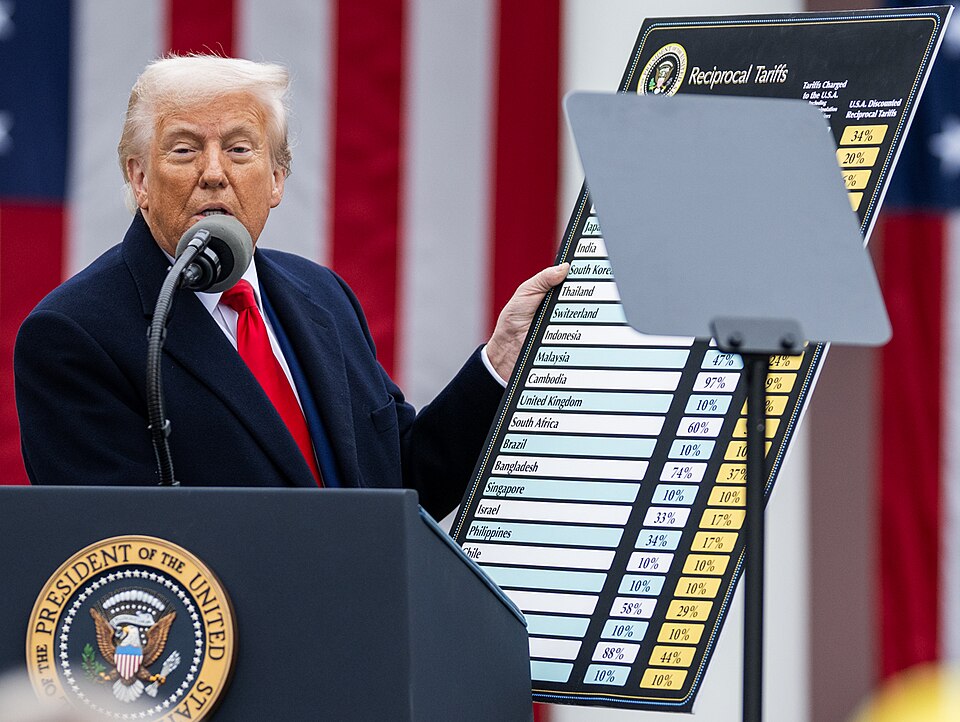
U.S. President Donald Trump holding a tariff chart at the event “Make America Wealthy Again” in 2025. (Photo: Daniel Torok/The White House)
Such unequal treaties serve two purposes simultaneously. First, they counter the stagnation of the U.S. economy by increasing the level of activity and employment through a rise in net exports, rather than a rise in state expenditure; hence the opposition of finance capital to larger fiscal deficits and taxes on the rich becomes immaterial. Second, they reduce the current account deficit of the U.S. and thus contribute toward a strengthening of the dollar. Therefore, both problems facing U.S. imperialism are simultaneously addressed by such treaties.
The second strand of the recolonization effort, apart from the imposition of unequal treaties, is control over the Global South’s resources, especially oil, but also including other critical resources like rare earths, for which the U.S. has designs over Greenland. While the U.S. is already the largest producer of oil in the world, should it come to control the oil resources of countries like Venezuela, which has the largest reserves among all countries of the world, and Iran, then it would have a stranglehold over the world’s oil industry.
This would strengthen the position of the dollar in at least three ways. First, the use of the dollar in oil transactions will remain unimpaired, so that the importance of the dollar will not be overtaken by any other currency. Second, the U.S. can thereby ensure that the expectation of stability in the dollar price of oil, which contributes to the stability of the value of the dollar, continues unabated. Third, with U.S. firms taking control of the oil resources in countries of the Global South, not only would the global strategic position of the U.S. be strengthened, but the scope for a ‘drain of wealth’ from the Global South to the U.S., that is, a pure siphoning off of surplus without any quid pro quo, would also be strengthened. This would help to reduce the U.S. current account deficit, as well as counter the possible threats to the hegemony of the dollar and hence to the financial system of the capitalist world.
Recolonization therefore, by obtaining captive markets in the Global South and by exacting a ‘tribute’ from it, would help in overcoming the twin problems faced by U.S. imperialism; it constitutes a cornerstone of Trump’s economic strategy. The issue here is not whether recolonization will be sufficient to overcome the crisis faced by U.S. imperialism; the issue is that this is Trump’s strategy.
III
For the Global South, such recolonization would mean a reversal of the gains it had made in the postwar period. The postwar conjuncture had made political decolonization inevitable; but imperialism had hoped that notwithstanding political decolonization it would retain control over the resources of the Global South. The process of economic decolonization, therefore, was far more arduous than political decolonization had been for the decolonized countries. Economic decolonization in fact was stoutly resisted by imperialism through a host of measures from coups d’etat to fomenting of civil wars in these countries.
When Jacobo Arbenz of Guatemala implemented land reforms by taking over large tracts of unused land from a U.S. firm, the United Fruit Company, a coup was staged by the CIA in 1954 to overthrow Arbenz. When Mohammad Mossadegh in Iran nationalized that country’s oil industry, ending British control over Iranian oil via the Anglo-Iranian Oil Company, the CIA and the MI-6 organized a coup in 1953 to overthrow Mossadegh and put an end to democracy there by installing Shah Reza Pahlavi as the ruler. When Gemal Abdel Nasser in Egypt nationalized the Suez Canal, he had to face an Anglo-French invasion in 1956, which failed because it was not supported by the U.S. and because the Soviet Union stoutly opposed it. When Patrice Lumumba threatened to nationalize the mineral resources of Congo, U.S. and Belgian interests encouraged a secessionist movement in the mineral-rich Katanga province, and got Lumumba assassinated in 1961. When Salvador Allende in Chile nationalized major sectors of the economy, including above all the copper mining industry that had been controlled by U.S. companies, he was assassinated in a CIA-supported coup in 1973.
One can go on citing instances. Imperialism did not always succeed; even in cases where it had intervened in this manner, there was not necessarily a return to status quo ante. Trump is now seeking to reverse this entire process of economic decolonization, and in a wholly unprecedented manner. Imperialist opposition to economic decolonization had hitherto taken the form of intervening clandestinely through local proxies propped up by coups d’etat or through civil wars. With Trump, however, we have for the first time direct military intervention by the U.S. to recolonize the Global South; and Venezuela and Iran are the obvious examples of it.
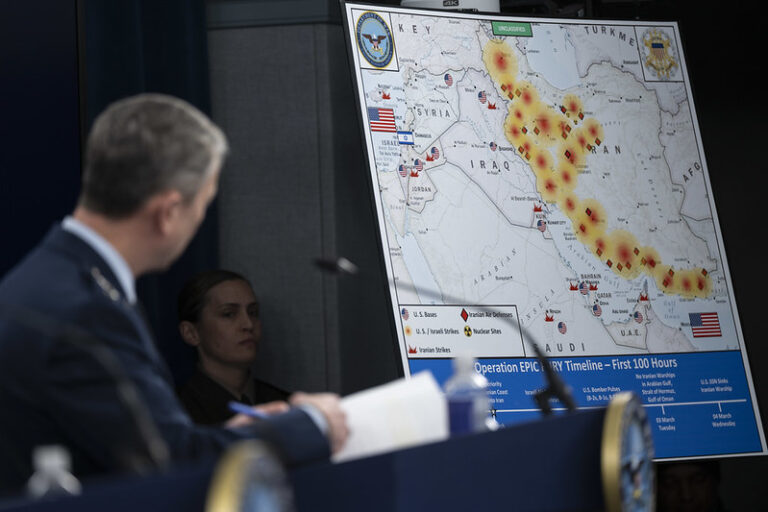
The timeline of Operation Epic Fury was shown at a press briefing in March 2026. (Photo: U.S. Secretary of War)
The arguments advanced by the U.S. for intervention in Iran do not stand up to scrutiny. The International Atomic Energy Agency did not find any evidence that Iran was manufacturing nuclear weapons as claimed by the US; and if that was the worry of the U.S. (let us momentarily forget Iran’s right to develop a nuclear weapon if Israel has a nuclear arsenal), then the U.S. should not have unilaterally abrogated its nuclear agreement with Iran. The talk of Iran posing a nuclear threat was therefore just a flimsy excuse; the real objective of the U.S.—Israel armed intervention in Iran was ‘regime change’, which means the installation of a regime that would do the biddings of U.S. imperialism.
Citing the oppressiveness of Iran’s current political system to justify such an effort at ‘regime change’ is utterly irrelevant: any change of ‘regime’ in a country is a matter for the people of that country alone, except when the UN itself uses sanctions to signify opposition to such a ‘regime’, as it had done in the case of Apartheid South Africa. However, that involves the UN, not a foreign power. The attack on Iran therefore is not for the reasons usually adduced for it; it is for ‘regime change’ where the objective is to install an obedient ‘regime’ that would let the U.S. control its resources. This is what Trump has in store for the entire Global South. The attack on Iran therefore is not just a bilateral matter; it is a step in the direction of recolonization of the Global South, a harbinger through sheer armed might of a new version of the old colonial empire.
IV
The Global South, however, will not surrender the gains of economic decolonization without a struggle. True, the monopoly bourgeoisie of the South, and even certain segments of the urban middle class that would like its progeny to emigrate to and settle in the metropolis would not join this struggle and might even be complicit in the imperialist project; and they may not only be ‘spared’ the adverse effects of recolonization, but even made beneficiaries of it. But the peasants, the petty producers, the small capitalists, the workers, and the agricultural laborers, all those who remain committed to the idea of decolonization and who would also be the victims of recolonization, would resist such recolonization.6 It is also true that the process of a country’s losing control over its resources had begun earlier with the pursuit of neoliberal policies; but recolonization is meant to carry the process to completion and to introduce the above-mentioned features, namely captive markets and extracting a ‘tribute’, that imperialism is now in need of.
There is a dialectics of aggression and also a dialectics of resistance involved here. Imperialism was emboldened to attack Iran because of the relative ease with which it carried out its operations in Venezuela; and had the regime change in Iran occurred as easily as imperialism had imagined, then it would have been further emboldened to carry its attacks immediately to other countries. But the resistance in Iran, which came as a big surprise for it, has stopped it in its tracks for the time being (see other Roundtable Comments). Not that it will abandon its project of recolonization, but it will be more circumspect in proceeding with it.
Likewise the example of Iran’s resistance will breathe new life into other countries that are in line to be the next targets of U.S. armed aggression. And in multilateral fora, countries of the Global South, which have been quite timid in expressing opposition to imperialism until now, will be more assertive because of the intrepid nature of Iranian resistance. What is happening in Iran, therefore, will shape the unfolding events in the entire Global South in the months to come.
Disclosure statement
No potential conflict of interest was reported by the author.
Notes:
1. The decadal growth rate of the world economy in the decade of the 2010s, even before the pandemic, was lower than for any preceding decade since the Second World war. For a discussion of the crisis of neoliberal capitalism, see Patnaik and Patnaik. The present paper relies heavily on the arguments advanced in that book.
2. While the opposition of finance to higher taxes on the rich is obvious (for the financiers are among the richest), its opposition to fiscal deficits was clearly displayed when the government of Liz Truss in Britain announced a budget strategy involving increased fiscal deficit. There was a financial outflow from Britain resulting in a fall in the value of the pound sterling, and Liz Truss had to resign, becoming the briefest serving Prime Minister in British history.
3. For the role of price expectations in ensuring financial stability in the capitalist world, see Patnaik.
4. For a discussion of this unequal trade treaty, see Dhar.
5. For the role of such markets and also of Britain extracting a ‘tribute’ (though this is not the language used by the author), see Saul.
6. This was made amply clear when the Indian farmers, supported by the urban working class and the agricultural laborers, waged a year-long agitation against the Modi government’s attempt to withdraw state support for foodgrain production at the behest of U.S. imperialism. The agitation was eventually successful.
References
- Dhar, Biswajit. 2026. “India Has Accepted Gross Asymmetry.” Frontline, February 23.
- Patnaik, Prabhat. 2009. The Value of Money. New York: Columbia University Press.
- Patnaik, Utsa, and Prabhat Patnaik. 2021. Capital and Imperialism. New York: Monthly Review Press.
- Saul, S. B. 1960. Studies in British Overseas Trade. Liverpool: Liverpool University Press.
- Stiglitz, Joseph. 2013. “Inequality Is Holding Back the Recovery.” New York Times, January 13.