
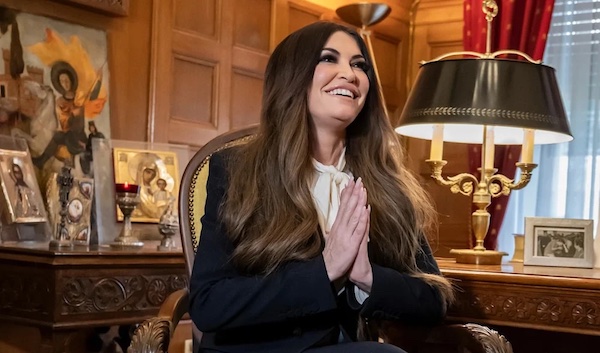
U.S. Donald Trump’s ambassador to Greece has triggered political controversy in Romania after suggesting that the United States could topple governments, in comments that appeared to reference political developments in Bucharest earlier this year, the Financial Times reported.
Kimberly Guilfoyle, a former fiancée of Donald Trump Jr. who was appointed ambassador last year, reportedly referred to the possible collapse of Romania’s government during a conversation with Greek Energy Minister Stavros Papastavrou, according to the Wall Street Journal.
“We can do that to any country we want. We can do that here,” Guilfoyle said, according to the WSJ. Papastavrou responded that the United States could not replace Greece’s democratically elected government.
Guilfoyle made the remarks about Romania on March 18 at an official dinner held at the U.S. Embassy in Athens, FT reported, citing a person familiar with the matter. More than a dozen people attended, including politicians, embassy personnel and military officials.
Romania’s government collapsed in May after the Social Democrats withdrew from the governing coalition and joined the far-right opposition in voting to oust Prime Minister Ilie Bolojan.
The U.S. embassies in Athens and Bucharest declined to comment, as per the report.
A U.S. State Department spokesperson said Washington “values its strategic partnership with Romania, which remains strong across our shared priorities, including energy security and defence burden shifting”.
The Greek government said, “There was never any question of a threat against the Greek government . . . nor would such a thing ever be tolerated.” It added that relations with Washington were “closer and more stable than ever”.
Guilfoyle met Romanian Social Democrats
After the Athens dinner, Guilfoyle traveled to Bucharest, where she met members of the Social Democratic Party, or PSD, in late March. Those present included party chairman Sorin Grindeanu and then-Energy Minister Bogdan Ivan.
It remains unclear whether Guilfoyle advised the Social Democrats to withdraw from the governing coalition.
The meeting between Guilfoyle and the Romanian Social Democrats “appeared conspiratorial” and should be reviewed, said centre-right EU lawmaker Siegfried Mureşan, who is seeking parliamentary backing to become prime minister on Wednesday.
“The matter is extremely serious,” Mureşan told the FT.
“Obviously Mr Grindeanu and his colleagues from the PSD need to tell us what they did, what they discussed and what goals they pursued at those meetings,” Mureşan said.
The centre-right bloc lost its parliamentary majority after the PSD left the government. Subsequent efforts to appoint a replacement for Bolojan have failed.
Political deadlock deepens
Mureşan is seeking parliamentary support to become prime minister in Wednesday’s vote.
If parliament rejects him, President Nicuşor Dan could ask the Social Democrats to form a government or call snap elections. Dan has previously said he wants to avoid an early vote because Romania cannot afford additional political instability.
The political turmoil has cost Romania billions of euros in lost EU funding, while major credit-rating agencies have warned that the country’s sovereign debt is approaching “junk” status, meaning it would fall below investment grade. S&P is scheduled to announce its latest rating decision Friday.
Energy dispute adds to tensions
Guilfoyle was in Bucharest in March to promote a gas route running from Greece through Bulgaria and Romania toward Ukraine, known as the Vertical Corridor.
She also pressed Romania to purchase substantial volumes of U.S. liquefied natural gas, according to two people familiar with the discussions.
Bolojan, a centre-right politician, supported the gas corridor initiative but declined to purchase significantly more U.S. LNG because Romania has substantial domestic gas resources, the people said.
Bolojan told the FT that his government was negotiating with the United States on developing the Vertical Corridor and linking Romania’s gas network with those of neighboring countries.
However, he emphasized that he had held no official talks with Guilfoyle and had signed no agreement to purchase LNG.
“Any positions expressed by other stakeholders do not represent the official position of the Romanian government,” he stressed.
The PSD opposed Bolojan’s position on purchasing additional American LNG, which was among the issues that ultimately contributed to its decision to leave the coalition, the people added.
Social Democrats deny U.S. collusion
Grindeanu rejected claims that his party had colluded with Washington.
“Ilie Bolojan was not overthrown by the Americans, nor by the Loch Ness monster, nor by Bigfoot, but by . . . Romanians who said that he was governing poorly,” he said Monday.
He nevertheless argued that the centre-right’s alleged anti-American position demonstrated “that we urgently need a government that will put the relationship with the U.S. back on track”.
Romania has sought to repair relations with the Trump administration after Washington singled out the country as undemocratic in 2025, following Bucharest’s decision to annul a presidential election over alleged Russian interference.
Dan, who was elected president last year after defeating pro-MAGA nationalist George Simion, has said he wants a stable government capable of restoring prosperity.
Ivan, the former energy minister, said the outgoing government was promoting “conspiracies” and accused former coalition partners of lying.
“They are desperate because they are losing power, they are hallucinating,” he said.
They are desperate when they see that [Mureşan] has no chance of getting through.
Coalition prospects remain uncertain
The political climate has become increasingly hostile, with reports of U.S. meddling adding to tensions. Independent strategist Radu Magdin of Bucharest-based consultancy Smartlink said the chances of a parliamentary majority forming around Mureşan were slim.
Romania’s two largest parties are the Social Democrats and the far-right AUR. Both maintain ties with Trump and voted together in May to bring down the Bolojan government.
“In Romania the trend seems to be turning,” Magdin said, toward a “formal or informal team-up” between the centre-left and the far right.