
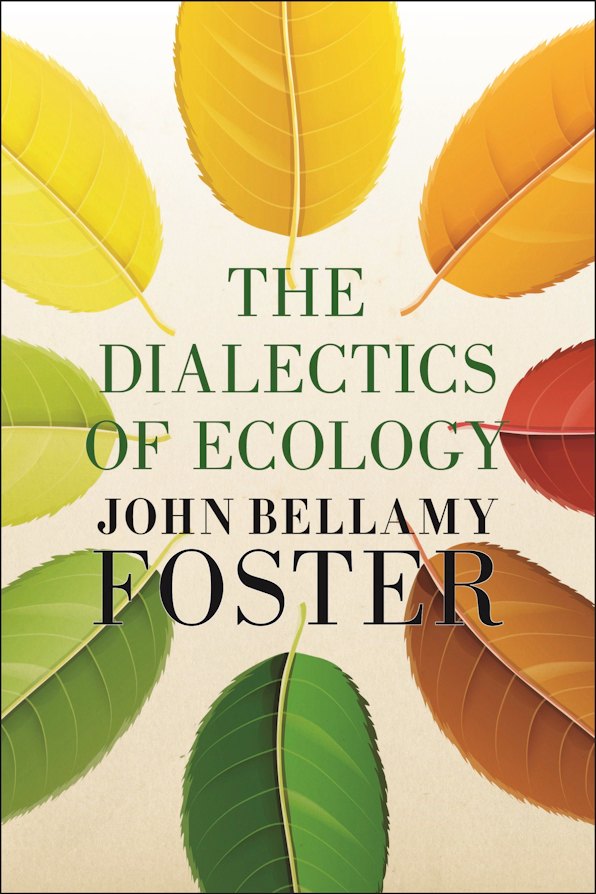
John Bellamy Foster, The Dialectics of Ecology (New York: Monthly Review Press, 2024), 360 pages, $29.00, paperback.
The Dialectics of Ecology by John Bellamy Foster is his latest book in a decades-long series of publications investigating the ecological principles latent in historical materialism. Those familiar with Foster are likely acquainted with his breakout text Marx’s Ecology (2000), or its highly esteemed “sequel,” The Return of Nature (2020), which are both historiographical texts. By contrast, what we find in The Dialectics of Ecology is Foster’s concern for today and for the bleak precarity of tomorrow. His goal is to demonstrate how and why dialectical critique remains suitably sensitive “to our own time…as we confront the twenty-first century planetary emergency” (9). Can the dialectical logic with which Marx imagined a global proletarian revolution so many years ago be leveraged towards an ecological revolution today? It should come as no surprise that Foster answers in the affirmative, nor that he goes a step further, that we must think dialectically if we are to have any hope at all: “The only answer” to planetary destruction “is the creation of a higher form of society,” one whose necessarily dialectical components are interwoven throughout the text (198).
I want to begin by laying out Foster’s conclusion. The final two chapters of The Dialectics of Ecology are dedicated to a vision of degrowth socialism, precisely that higher form of society alluded to above. What defines Foster’s socialism is the introduction of a planned economy, a systematic appropriation of the environment designed to avoid ecological devastation while promoting human welfare, which, for Foster, are one and the same thing. To “aim at human flourishing,” our global society must maintain “a sustainable social metabolism with the earth” (268). What sets Foster’s vision apart from more familiar accounts of socialist planning, like those of Ernest Mandel and Oskar Lange, is the unique subject positioned to be that plan’s author. Rather than allocate planning to the state (Lange) or to a radically democratic collective of associated producers (Mandel), Foster entrusts an emerging class whose neologistic phrasing may well prove prophetic: the environmental proletariat. To name and describe this incipient subject is perhaps the main contribution of The Dialectics of Ecology. They are a class defined by “the dual alienation of an externalized nature and of human labor” (71) reflecting how “the capitalist domination of nature [has] become a means of dominating human beings” (91), so that, even today, their “class struggle of production is converging with the class-based environmental justice struggles over food, air, water, and the conditions of social and ecological reproduction” (155). To understand this dual alienation from which Foster’s environmental proletariat emerges, and the consequences it portends for tomorrow’s socialist governance, is to have understood the bulk of The Dialectics of Ecology.
As we will discover, there is little to criticize and much to appreciate about Foster’s nuanced and impressively capacious perspective on Marx and Engels’s joint oeuvre. What some leftist readers will find wanting, however, is the book’s rather reductive attempt at engaging the landscape of materialism today, particularly Chinese state socialism and posthumanist “new materialisms.” While posthumanism is antagonized as a heretical threat to praxis, “socialism with Chinese characteristics” is taken to be completely consistent with Marx’s vision of historical materialism. The consequences of these simplifications are visible in whom the text designates as its ally in the overcoming of capitalism: state governance under Xi Jinping (however conservative) rather than the heterodox left. That said, even the heterodox thinkers among us will find The Dialectics of Ecology to be a deeply persuasive text whose vision of the future is certainly thinkable, if not, perhaps, inevitably forthcoming.
Foster’s introduction and first three chapters introduce the dialectical tradition through a close reading of its practitioners, relying heavily on Friedrich Engels’s Anti-During (1878) and The Dialectics of Nature (1925). The type of dialectics propounded by Foster will remain a crucial premise throughout the text, and it amounts to this: the logic according to which reality progressively emerges out of contradiction (dialectics) is not limited to the development of the historical subject (à la Hegel or Lukács) but is immanent to and defines the transformation of nonhuman nature. At the core of this interpretation are three dialectical laws introduced by Engels in The Dialectics of Nature: the transformation of quantity into quality, the identity of identity and non-identity, and the negation of the negation. Together these form a socio-natural theory of emergence, where specific quantities of matter and energy potentiate emergent, or qualitative changes, so as to develop beyond the contradictions within their sphere of interaction. Dialectics, for Foster as for Engels, presents a law governing “all motion…a “single science” looked at “from two sides,” those of natural history and human history” (84–85). That dialectics should govern both “sides” of history has quite the consequence. It suggests that nature, by its own dialectical movement, may sublate (or abolish) humanity if the two become diametrically opposed. Nature may take its “revenge” (95).
The plausibility of this potentially disastrous dialectical exchange between human and nonhuman nature was first described by Foster in Marx’s Ecology as Marx’s theory of “metabolic rift,” and it goes on to play an important role in The Dialectics of Ecology as well. For Marx, as for Foster, a “rift” has opened between the regular reproduction of humans and of nonhuman nature under capitalism, epitomized for Marx by agribusinesses’ propensity to rob the soil of its own capacity for reproducing nutrients (140). Like all dialectical movement, this opposition is subject to negation, to “the negation of the negation,” by which any and all longstanding contradictions are overcome. Foster envisions two possible overcomings: “the negation of the material conditions of human society” (nature’s revenge enacted) “or else the negation of the capitalist mode of production” (planned socialism) (95). At the heart of this dialectical exchange are the “environmental proletariat,” who recognize that labor, the means by which humans metabolize nature, must become the battleground in which we take back earth’s equilibrium.
While establishing this rift, we should note that Foster introduces and swiftly dismisses posthumanism as a theoretical alternative to dialectics. Foster’s claim is that posthumanists falsely imagine reality to be a “flat, monistic world of objects without subjects,” so that even “human praxis itself” becomes unthinkable (74). A cogent argument might proceed by focusing on how subjects appear or disappear in posthumanist texts—a nod to the origin of the subject within intra-action, différance, or territorialization. Rather than confront a foundational text, though, Foster levies his argument against object-oriented ontologist Timothy Morton (exposing the latter for his failed understanding of commodity fetishism) and considers the task done. The consequence is a hurriedly burned bridge between new and historical materialisms, and between two sides of the left, just as a shared concern for ecology is rising to the fore.
Chapters four through seven of The Dialectics of Ecology present a fine-grained genealogical interpretation of two contemporary responses to the environmental crisis: capital’s financialization of nature through natural asset companies (NACs) on one hand, and China’s planned pursuit of an “ecological civilization” on the other. For Foster, the two are diametrically opposed. While the former would “save” nature by bringing it under the law of the market (homogenizing ecosystem services into tradeable tokens), the latter would bring China’s economy under “the laws of nature” (163). Foster traces this division between East and West to a more basic misunderstanding of value: for Western economists exchange-value accumulates according to a mathematical model of infinite growth (e.g. debt and interest), but they miss the fact that value’s basis in “real wealth” is nevertheless subject to the physical limitations of nature’s finite energy flows (e.g. photosynthesis) (142–43). The difference, in theory at least, is between an economy that acknowledges and one that fails to acknowledge the limits to growth imposed by nature. This analysis bolsters Foster’s conclusion: If the energy accessible to capital is finite, this means that its appropriation must be rationally planned; and if this rational planning is already underway in China, the environmental proletariat are surely forthcoming.
Foster’s analytical distinction between two purportedly opposed economies may strike some of us as wishful thinking. Hasn’t China, rather than opposing the global dominance of capital, in fact plugged into it? This critical question, as well as its live debate among Marxists today, is only obliquely addressed by Foster (China’s carbon emissions are addressed, for instance, but not labor). This may be because a confrontation with China’s own economic contradictions risks complicating an otherwise prognostic vision that the environmental proletariat, nascent in China, “is destined to come about in the coming decades” (238). For those interested, Jerry Harris (2024) has produced a general overview of this debate, acknowledging on the one hand China’s “super exploitation” of labor worldwide, whose “wage gaps are so great they rival US rates of exploitation” (Harris 66), while also recognizing that the Chinese state’s ability to finance developing nations has usefully circumvented the West’s monopoly on debt, and with it, neoliberal restructuring.
This debate has stakes. Many of us will remember the suicide nets strung along the Foxconn manufacturies of Shenzhen after a series of militant workers’ protests culminated in the suicide of 23 Foxconn employees between 2010 and 2018. Few of us are likely acquainted with the departing poem that preceded the militant actions of Xu, one such laborer (cited in Nao 2014):
I want to take another look at the ocean, behold the vastness of tears from half a lifetime
I want to climb another mountain, try to call back the soul that I’ve lost
I want to touch the sky, feel that blueness so light
But I can’t do any of this, so I’m leaving this world
Xu’s poetry nearly names the dual alienation of workers from ecology and labor that defines Foster’s innovative vision of the environmental proletariat, but, at least in this case, their emergence seems to be occurring in spite of, rather than through, Chinese socialism. To my eyes, twelve-hour work days, rather than state-sanctioned consciousness raising, were and remain the proof that in China (as elsewhere) we must alter the conditions under which we labor.
The Dialectics of Ecology stands alongside Marx’s Ecology and The Return of Nature as one of the best texts on ecological socialism written to date. Foster’s confidence in a single, forthcoming solution—economic planning by the environmental proletariat—hones his text to a razor-sharp level of organizational and argumentative acuity, but may have forestalled real engagement with the differences of other traditions, including contemporary China’s own divergence from state socialism. Why a government that continues to subsidize the theft of labor should be praised as revolutionary, rather than an anti-authoritarian (if conceptually diverse) left remains deeply unconsidered. No matter the leftist, though, this text is well worth their readership.
References
Nao Project, “The Poetry and Brief Life of a Foxconn Worker: Xu Lizhi (1990–2014),” Libcom, 2014, https://libcom.org/article/poetry-and-brief-life-foxconn-worker-xu-lizhi-1990-2014.
Jerry Harris, “Is China an Imperialist Power?” Race and Class 66, No. 2(2024): 63–87.
John Bellamy Foster responds
I very much appreciated Nicholas Denning’s very insightful review of my book The Dialectics of Ecology, in which he delved in illuminating fashion into its larger vision and offered useful critical points. The one important criticism presented in his review, to which I would like to reply, has to do with the challenge he offers to the view of China presented in two chapters near the end. Here it is suggested that I took too rosy a view of China and did not address the way it is actually “plugged into” the “global dominance of capital.” This obviously raises very complex issues from a historical materialist standpoint. It is a common mistake in the West to treat China as a monolith or as a set model, rather than as a complex society engaged in internal struggles, in a constant state of transformation, with its own inner contradictions, everywhere in flux. China is best seen as a hybrid society, neither entirely socialist nor entirely capitalist, but rather a post-revolutionary society of a sui generis type. It is an emerging economy within the Global South that has managed to develop its own sovereign path not subject to the domination of the imperialist world system centered in the triad of Europe, North America, and Japan. In 1978, it should be remembered, China still had a per capita income that was only one-third that of sub-Saharan Africa, while in 1981, more than 800 million Chinese were living on less than $1.25 a day.
None of this means that one should turn away from issues of wage exploitation and inequality in China, matters that I wrote about with Robert W. McChesney in our book The Endless Crisis (2012). Nevertheless, China, through its self-designated “Socialism with Chinese characteristics,” is rapidly opening up new possibilities, of which the struggle to create an ecological civilization is clearly one. Given the absolute severity of today’s planetary emergency, which now threatens all of humanity and all other beings on the earth, it is necessary for us to look for feasible paths out of the current deadly trap in which the world is placed. The enormous, creative environmental struggles of China—the product not just of the Chinese state but emanating even more from the mass struggles of the Chinese people outside the state, which are largely unknown in the West—is forging one such potential alternative path, making China the world leader in alternative energy, though one cannot discount China’s still enormous contributions to world CO2 emissions. Other paths to a sustainable society are to be found outside China in planned degrowth (directed at the wealthiest most wasteful countries), the communes in Venezuela, and struggles everywhere in the world driven by an emerging environmental proletariat and aimed at sustainable human development. To point to environmental advances in China, and to defend the efforts—both at the level of the state and the grassroots—to promote sustainable human development there, is no more to suspend all critical judgment toward that society than if one were to find hope in ecological advances in the West (unfortunately few and far between today) despite the larger exploitative character of the society. If China has managed to promote ecological civilization in a way not to be found elsewhere, it is because of their revolution and altered social relations, as imperfect as they must be. Historical materialism is not so much a vision as a critical method and a revolutionary practice. In the state of the world today, we must examine all avenues and historical possibilities that offer hope for the revolutionary reconstitution of the social metabolism a whole by the associated producers, and the creation of a world of substantive equality and ecological sustainability—the dual goals of twenty-first-century socialism.