
Victory at Jantar Mantar
On July 25, the cockroaches were dancing at Delhi’s Jantar Mantar. They were dancing because they had won, their cheers reverberating through the streets of India’s national capital. After seven weeks of youth-led mobilisation and sustained protest, India’s federal education minister, Dharmendra Pradhan, had resigned.
Around them was a Gen Z protest culture that had rejected the conventional costume of political seriousness: battered examination guides, dance and music performances, comic placards, “get ready with me” protest videos, music edits and jokes about unemployment.
What critics had dismissed as spectacle now accompanied a concession from a government rarely seen yielding to public pressure. Later that evening, movement leaders announced that the government had accepted their key demands and asked protesters to return home peacefully.
Online, the protest had spread in a language even less familiar to the political establishment. A government minister’s refusal to resign became a joke about India’s shortage of employment: perhaps, protesters suggested, he was holding on because he could not find another job. Others waited for “AI to take his job.” On July 25, the joke acquired an impressive political ending.
A protest mocked for looking unserious had produced a serious result. But its achievement raises a larger question: who gets to decide what legitimate dissent should look and feel like?
Pressure To Perform Suffering
The jokes did not make everyone laugh. Clips of protesters dancing and making reels provoked outrage among those who could not comprehend this language of protest. How could they dance when students were suffering? How could they make sarcastic reels about lost futures and young people reportedly driven to suicide? If the crisis was serious, should its protesters not look serious too?
Behind these questions lies a rigid idea of political credibility: authentic resistance must be performed through visible suffering and stoicism. Protesters may shout in anger, but they must not laugh too loudly. They may endure violence, but they must not enjoy one another’s company. The moment they sing, dance, dress up or make art, their commitment becomes suspect and their grievances easier to dismiss.
The cockroach movement refused this prescribed role and asserted emotional sovereignty: the right of citizens to determine the emotional terms on which they challenge power. It does not mean that participants control everything they feel or that pain disappears when a song begins. It means that neither the state nor the media should be allowed to prescribe a single emotional performance as the price of being believed.

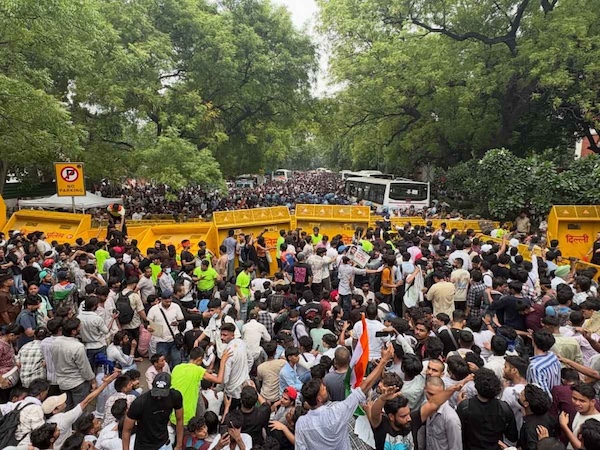
What started as an online campaign quickly translated into sustained street mobilization, culminating in a planned march to Parliament during the opening of the Monsoon Session. Image: Tahir Bhat
How An Insult Became A Movement
The movement began with a social media post responding to remarks by Chief Justice of India Surya Kant that were widely interpreted as comparing unemployed young people to cockroaches. Kant later said that he had been misconstrued and was referring only to people entering the legal profession with fake degrees. By then, however, the insult had acquired another life.
Young Indians called themselves cockroaches not because they accepted the insult, but because reclaiming it deprived the word of its power to humiliate them. The object of disgust became a mascot, then a satirical platform and eventually a movement. By late July, the Cockroach Janata Party’s (CJP) Instagram account showed more than 26 million followers. That digital public moved into the streets. The first major Delhi demonstration took place on June 6, joining anger over unemployment with repeated examination irregularities, including a medical entrance-exam leak affecting roughly two million candidates.
A sustained agitation at Jantar Mantar in New Delhi followed. The movement grew after educator and activist Sonam Wangchuk began a hunger strike, and again after police used batons and tear gas against demonstrators attempting to march towards the Indian Parliament on July 20. What began as a demand for education reform became an argument about how the state treated a generation whose faith in education as a route to mobility was already fraying.
On July 25, Pradhan resigned. Protest leaders said the government had also agreed to examination reform, compensation for families of students who died by suicide and the withdrawal of cases against demonstrators. The following day, Prime Minister Narendra Modi announced a task force to overhaul the examination system and promised legislation against paper leaks. But the political concession did not settle the argument over how the protesters had behaved.
Once the demonstrations subsided, the ruling Bhartiya Janata Party’s (BJP) politicians and social media users began recasting the movement’s humour as evidence of indiscipline and disrespect.
The struggle over the movement’s emotional legitimacy did not end here. Videos of CJP organisers dancing at a hotel after Pradhan’s resignation produced a fresh wave of criticism from ministers in the ruling government and social-media users, who presented celebration as evidence of insincerity or moral failure.
For instance, BJP parliamentarian Kangana Ranaut called the protest reels “puke-inducing” and “crass,” described their creators as “filth, garbage and ugliness,” and singled out young women as “Generation Gutter.” She did not dispute only what the protesters had said. The actor-turned-politician attacked how they spoke, dressed, celebrated and inhabited their freedom. The movement had won a political demand, but its opponents were still trying to use its joy as evidence that its participants didn’t deserve respect.
Modi’s own language was less openly hostile but remained paternalistic. A week after the resignation, he referred to the protesters as “misled children” who should be guided rather than punished. Meanwhile, punishment was already taking other forms.
Young men and especially women whose protest videos circulated online were subjected to a coordinated campaign of online harassment and doxxing (accounts published names, photographs, phone numbers, workplaces and home addresses of protesters and encouraged followers to “teach them a lesson”).
Some women reported rape and death threats, abusive calls and offline intimidation. Police also registered cases and sought information about social-media users accused of insulting Modi. Despite their victory, efforts to discipline Gen Z followed them home.
How Joy Acquires Political Force
The transformation of “cockroach” from humiliation into collective identity gave scattered grievances a shared language that was emotionally resilient and difficult to ridicule from above. Authoritarian and majoritarian politics often depends upon controlling not only institutions and information, but also the emotional roles available to citizens.
Those in power present themselves as commanding, dignified and firmly in control; their opponents are cast as angry, chaotic, dangerous or desperate. Once dissenters accept that script, they must continually display their wounds to prove that they deserve to be heard.
Satire disrupts the arrangement. It shrinks the distance between rulers and ruled. An authority may defend itself against an accusation; it is harder to defend itself against ridicule without appearing thin-skinned.
As the English writer George Orwell wrote in his 1945 essay “Funny, but Not Vulgar,” “Every joke is a tiny revolution.” A joke cannot dismantle a system. It can, however, briefly overturn the hierarchy on which that system’s dignity rests.
Similarly, Dutch social historian Marjolein’t Hart describes humour as both a means of building collective identity and a “weapon of the weak.” Her research on humour and social protest shows how jokes let movements frame conflict in their own terms, communicate beyond committed activists and create unity among people who had previously experienced their grievances in isolation.
A protest site is never only a platform from which demands are addressed to the state. It also becomes a place where people briefly build a life together. People distribute food, exchange stories, sing songs, play music, make friends, and discover that what they had experienced as an individual frustration or failure may have a political cause. The movement must produce not only arguments, but also belonging.
India saw this during the 2019—20 protests against the Citizenship Amendment Act (CAA) and proposed National Register of Citizens. At Delhi’s Shaheen Bagh, Muslim women transformed a public road through poetry, murals, food, conversation and music. Research has examined how the women-led occupation reimagined citizenship and belonging.
The cockroach protests created a different but related public. Students and jobseekers stood alongside families, professionals, artists and activists. This did not dissolve India’s divisions of class, religion, caste, age or gender. It did, for a time, give people with different relationships to the education crisis a shared place and vocabulary.
Different Revolts, A Shared Vocabulary
The cockroach movement also belongs to a more recent South Asian pattern in which Gen Z has carried a digitally formed political language into the street. In Bangladesh in 2024, demonstrations that began over quotas in government employment widened into an uprising against then Prime Minister Sheikh Hasina’s increasingly authoritarian rule.
A decisive emotional rupture came when Hasina’s remarks were understood as casting the protesting students as Razakars, a term associated with those who collaborated with Pakistan’s army during the 1971 Liberation War. Rather than simply reject the label, students repeated it ironically in slogans and memes, turning an attempt at humiliation into a shared identity.
Bangladesh’s uprising was neither fully playful nor joyful. Protesters faced an internet blackout and lethal state violence before Hasina resigned and fled the country on August 5. Yet creativity persisted inside that danger. Graffiti, cartoons and memes turned walls and screens into records of resistance, while rap songs such as “Kotha Ko” (speak up) and “Awaz Utha” (raise your voice) circulated through YouTube and Facebook, documenting state violence in a language distinct from the traditional protest music of earlier generations.
As Bangladeshi political scientist Navine Murshid has written, these songs gave anger, hope and defiance a generational form and their online audiences became virtual gathering places. After the uprising, young people covered public walls with hundreds of murals and graffiti that commemorated the dead while turning grief and frustration into collective expression.
Nepal’s Gen Z uprising in September 2025 made the journey from online discontent to political upheaval in a matter of days. A government ban on 26 social-media and messaging platforms became the immediate trigger for protests already fuelled by corruption, unemployment and the conspicuous privilege of politicians’ children who became the targets of a viral “Nepo Baby” campaign.

Students launched ‘Bangla Blockade’ for scrapping quotas in public service and keeping a minimum quota for marginalised citizens in line with the constitution. Image: WIkimedia Commons
Students launched ‘Bangla Blockade’ for scrapping quotas in public service and keeping a minimum quota for marginalised citizens in line with the constitution. Image: WIkimedia Commons
Tens of thousands gathered in Kathmandu after an online call; students arrived with anti-corruption placards, and a rapper performed at the rally before police gunfire turned it deadly. After Prime Minister KP Sharma Oli’s government collapsed, young Nepalis moved from the street back onto Discord and debated whom to nominate as interim prime minister. Thus a digital space became part of an improvised political process.
The differences matter as much as the similarities. Bangladesh’s uprising emerged from a quota dispute and escalated through weeks of repression. Nepal’s was catalysed by an attempt to close the very platforms through which a generation spoke and organised. India’s cockroach movement pursued more specific institutional wrongdoings.
None proves that Gen Z shares a single ideology. Together, however, they show a regional generation blurring the lines between supposedly trivial online expression and serious public action. The memes and music proved potent in politicising a generation often dismissed as mere consumers and creators of online content.
Joy Is A Capacity, Not A Strategy By Itself
The anarchist, activist and feminist Emma Goldman wrote about this more than a century ago. In her autobiography, she recalled being reprimanded for dancing with “reckless abandon”: such frivolity, a young comrade told her, was unbecoming of a serious agitator. Goldman rejected the idea that a movement devoted to liberation should demand “the denial of life and joy.”
A cause promising freedom, she argued, could not require its participants to extinguish the freedom, beauty and self-expression already available to them.
Repressive politics does not rely exclusively on fear; it also benefits from fatigue. When every image of dissent shows anger and suffering, it can create a sense of helplessness and distance from the cause. If people begin to feel that participation offers only danger, sacrifice and disappointment, the movement cannot survive for long.
On the contrary, a movement that also produces friendship, humour and creativity offers connection and reasons to remain. The Cockroach Janta Party’s message was clear: those in power do not get to decide how protesters experience and express their resistance.
This does not negate that humour can alienate as easily as it connects. Online irony can flatten political differences, and is in no way a substitute for on-the-ground mobilisation. Some people can dance and leave, while others remain exposed to surveillance, arrest or violence.
Memes did not negotiate the cockroach movement’s settlement; organisers meeting ministers did. Songs did not produce an examination-reform task force; sustained mobilisation, a hunger strike, swelling crowds and opposition pressure did.
Joy should not be isolated from those forces as though it were an independent variable that caused a minister to resign. Its role was infrastructural. It helped create a collective identity. The cockroach movement did not prevail because it was joyful, and it did not prevail despite being joyful. Joy was one of the practices through which it resisted exhaustion.
Joy brought a fragment of the desired future into the present. It was not an escape from politics, but evidence of what the struggle is for.