
-

Higher hospital prices mean smaller paychecks and inflated premiums
State legislatures can intervene to help control costs.
-

Will betting on wildfires lead to arson?
Fire survivors say using prediction markets to gamble on wildfire is “morally reprehensible.”
-
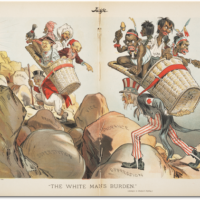
The irrationality of world trade arrangements
Amazingly the world trading arrangements are such that the inferior mode of adjustment is carried out whenever there are imbalances, and not the superior mode of adjustment. This is the irrationality of the world trading arrangements under which we live.
-
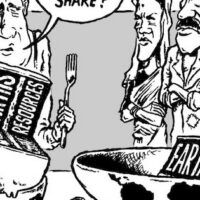
Capitalism, employment and history
What is true of the world economy as a whole holds true for countries like India which have enormous labour reserves inherited from the colonial times, reserves hidden away in particular in vast agrarian sectors.
-

Bloomsday as Everyday
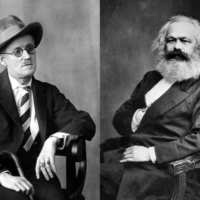
If Marx in Capital lays bare the “hidden” abode of capitalist production, Joyce, in Ulysses, lays bare the hidden (yet all-too-visible) abode of modern reproduction, the arena that’s both the starting and end point of progressive politics, decreeing its victory or defeat.
-

Major study shows world sees USA as biggest threat, and prefers China
A global survey found people in most countries see the United States as the biggest threat to the world, and prefer China over the U.S. These are the results of the EU-backed Democracy Perception Index.
-

3 alarming signs Elon Musk wealth marks a new era of corporate tech fascism
Elon Musk wealth has made him the first trillionaire, after SpaceX’s Nasdaq debut exposed extreme inequality, speculative finance, and corporate power.
-
Capitalism: A Global History – book review
This enormous history of capitalism provides much fascinating detail, but its flawed conceptualisation of the system’s history undermines it, argues Dominic Alexander.
-

The chimera of a reformed capitalism
Today India has a level of income inequality higher than at any time in the previous one hundred years, and one of the highest in the world
-

Book Review: ‘Paper Girl: A Memoir of Home and Family in Fractured America’, by Beth Macy
One of the poorest kids in town, Macy was more neglected than abused by her alcoholic father, “the town drunk.” She “found refuge” in her friends’ homes or the living room of her grandmother who taught her to read and write and play checkers. She “took solace” in the nearby public library and the public school and “the women in charge of those sacred places who were also my demigods.”
-
AI: Just one big trade
If AI is to succeed for capital, it will only be at the expense of most working people and their families.
-

Tech bosses cut nearly 150,000 workers as profits pour into AI machinery
The question is not whether AI will enter the workplace. It already has.
-

There is no outside: What the Devil wears Prada gets right about capitalism
In the popular 2006 film The Devil Wears Prada, Miranda Priestly, the primary antagonist, played brilliantly by Meryl Streep, is the editor-in-chief of the luxury fashion magazine Runway.
-
Stevphen Shukaitis and Joanna Figiel: ‘The Wages of Dreamwork’ – Review
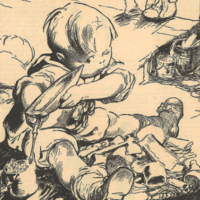
The ‘Wages of Dreamwork’ is an ambitious and timely contribution to debates on labour, culture and social reproduction under contemporary capitalism. Drawing from autonomist Marxism, feminist theory, critical management studies and the history of avant-garde artistic practice, Stevphen Shukaitis and Joanna Figiel examine how creativity, desire and the search for meaningful activity have become increasingly central to capitalist accumulation.
-

We can’t afford to grow up
Thoughts on the Peter Pan generation and how its shaped our relationship to money.
-

Mark Carney exposes the usually hidden fangs of capitalism
This government’s embrace of deregulation and extraction shows how deeply profit-driven assumptions shape public life.
-
The miners’ anger
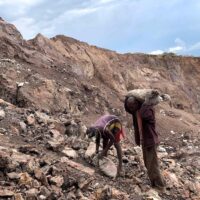
An attempt at understanding.
-

Inside Toronto’s growing tenant revolt
Tenant movements are emerging as one of the most significant movements of our era.
-

Congo’s cobalt feeds Big Tech. Its people face Ebola
Tech monopolies—Apple, Nvidia, Google, Microsoft and Intel—depend on mineral supply chains that run through eastern Congo.
-
Parallel Universes
Anybody who’s ever leafed through Finnegans Wake will quickly recognize that we’re not dealing here with a standard novel, just as anybody leafing through Marx’s Capital will know we’re not dealing with standard economics.